
In this article you’ll learn
- The difference between using a mortgage adviser and going directly to your bank
- Why the lowest interest rate isn’t always the most important factor
- How an adviser can help when one bank says no
- What an adviser can help with once you’ve found a property
- How an adviser can help with your loan structure beyond getting the mortgage approved
- When going direct to the bank might make sense — and when having an adviser in your corner could be useful
5-minute read
Should I use a mortgage adviser or go direct to the bank?
It’s one of the questions I see come up time and time again from first-home buyers:
“Should I use a mortgage adviser, or just go directly to the bank?”
Full disclosure: I’m a mortgage adviser, so yes, I’m biased.
But I also think it’s a completely fair question.
If you have a good income, a solid deposit, straightforward finances and you’re comfortable dealing with the bank yourself, there’s nothing stopping you from going direct.
But before you decide, it’s worth understanding what you’re actually getting when you work with a mortgage adviser.
Because it’s probably not what you think.
It’s not just about getting you the lowest interest rate.
In fact, I’d argue that’s one of the least interesting parts.
“But won’t an adviser just find me the best rate?”
This is probably one of the biggest misconceptions I hear.
People imagine mortgage advisers sitting around comparing interest rates all day and sending you to whoever is offering 4.99% instead of 5.09%.
Rates matter, obviously. But they can change between banks overnight.
What can matter much more is whether the lender’s lending policy and products actually suit you.
Different banks assess things differently. What do banks look at when assessing a home loan?
They can have different approaches to overtime, commission, self-employed income, expenses, credit history, low deposits, debt-to-income ratios, property types and plenty of other parts of an application.
My job isn’t simply to find whoever has the lowest rate today.
It’s to look at your overall situation and work out which lenders and products are worth considering for you.
Then you actually find a house
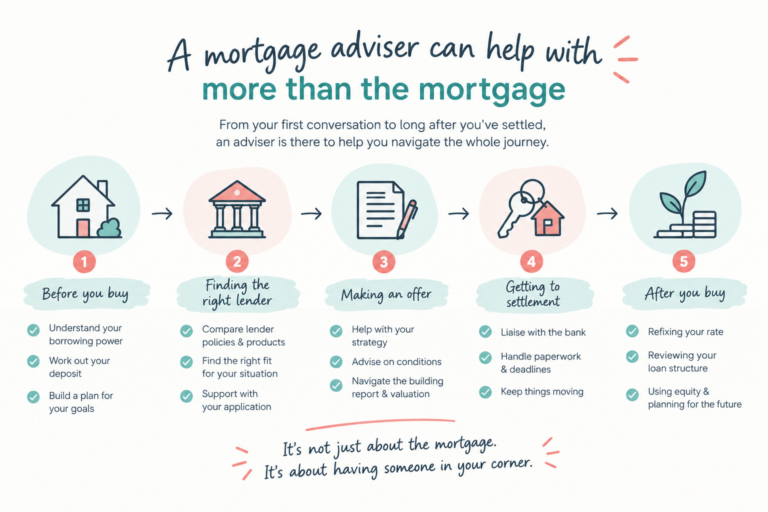
This is where I think the value of an adviser becomes very obvious.
Getting preapproved is one thing. Knowing what to do when you actually find a property is another.
Suddenly you’re dealing with an agent, an offer, finance conditions, a valuation, a building report, deadlines and potentially a whole lot of questions you’ve never had to ask before.
An adviser can help you work through those decisions as they come up.
What should you offer? What should you say to the agent? Does the property look suitable from a lending perspective? What happens if the valuation comes in low? What do you do when the building report raises an issue?
These are the parts of buying a first home that don’t necessarily come with your preapproval — and they’re often where having someone in your corner becomes really useful.
And if you’re still focused on reaching an arbitrary 20% deposit, it’s worth understanding how much deposit you actually need before assuming you’re not ready.
What happens if your bank says no?
This is another reason I think an adviser can be particularly useful for first-home buyers.
I regularly speak to people who have been told by their bank that they can’t borrow enough, or can’t get approved at all.
A “no” from one lender doesn’t necessarily mean there are no options. The important thing is understanding why the application didn’t work and whether another lender may assess the situation differently. I’ve written more about what can happen when the bank says no here.
Sometimes the answer really is no.
But sometimes it’s more complicated than that. Different banks can assess the same borrower differently.
Another lender may assess part of your income differently. Your expenses may be treated differently. A particular lender may have a policy that works better for your circumstances.
That’s one of the reasons I wrote about what to do when one bank says no. A “no” from one lender doesn’t necessarily mean you’re out of options.
It may simply mean we need to understand why they said no and whether another lender is a better fit.
Sometimes the value is in the hand-holding
Buying your first home is a big deal.
You’ve probably never negotiated a property purchase before. You may never have read a building report, organised a valuation or worked through finance conditions.
So yes, there are plenty of things you can Google.
But sometimes you don’t need another Google search.
You need someone to say:
“Yep, I’ve seen this before. Here’s what we’d do next.”
That’s a big part of my job.
You find a property at a Saturday open home? I’m often available over the weekend to help you work through an offer.
A building report comes back with something concerning? We can talk through what it means and what questions need asking.
You’re not sure what to say to the agent? We can work through that too.
Need to understand whether the property is likely to stack up from a lending perspective? That’s something we can look at before you get too far down the track.
And yes, I’m often up at 5am answering first-home-buyer questions.
Not because I think everyone should be awake at 5am.
But because buying your first home doesn’t always happen neatly between 9 and 5.

Real buyer story
“We have preapproval… now what?”
This couple had already obtained preapproval directly with ANZ when they came to me.
They hadn’t really needed help getting the initial approval. What they needed was help with everything that came afterwards.
They wanted to know how to make an offer, what to say to the agent, what conditions to include, what happened when the building report came back with issues and whether the property they were considering was actually worth what they were looking at paying.
We worked through those questions with them as they navigated the purchase.
Interestingly, they ultimately stayed with ANZ — the bank they’d already been preapproved with.
The value wasn’t finding them a different bank. It was having someone in their corner to guide them through the process, answer the questions that came up and help them understand what to do next.
And that’s something that doesn’t stop at settlement either. They’re able to come back to me when they’re looking at refixing, building equity or wondering whether they should change their loan structure.
Sometimes the value of an adviser isn’t changing your bank. It’s making the whole process easier to navigate.
It’s also about having someone in your corner
One of the biggest parts of my job isn’t actually submitting the application.
It’s advocating for my clients and helping them navigate the process.
I deal with banks every day.
I know what information they’re looking for, what questions to ask and how to work through the inevitable curveballs that come up.
I can also help connect you with other professionals you may need along the way, such as a lawyer, and help you understand what needs to happen next.
You’re still making the decisions.
I’m helping you understand your options and making the process easier to navigate.

Then there’s the bit that happens after the bank says yes
Getting the mortgage approved is not the finish line.
It’s the beginning of a very long relationship with your mortgage.
When we’re looking at your loan structure, we might consider things like:
How much equity you have
Whether splitting the loan makes sense
Whether an offset or revolving credit could be useful
How to make extra repayments
How to use future lump-sum payments
How to reduce low-equity margins as your equity increases
How the loan structure fits with your wider financial goals
And the relationship doesn’t have to end when you settle.
Clients can come back to me when they’re refixing, wondering whether to restructure, looking at using some of their equity, or simply wanting to know whether there’s something they should be doing differently.
That’s another part of the job I really enjoy.
The mortgage isn’t a one-off transaction. Your circumstances change, and your mortgage can change with them.
*Your first home faster action*
Have the conversation before you think you’re ready.
You don’t need to have your deposit sitting there or be ready to buy next weekend before speaking to a mortgage adviser.
If you’re wondering whether you could buy in the next 6, 12 or 18 months, find out what would need to happen between where you are now and getting a home loan.
That might mean understanding your borrowing power, working out how much deposit you’ll need, paying down some debt, tidying up your accounts or simply knowing what to focus on.
The earlier you know what needs to change, the sooner you can start working on it.
So… should you use a mortgage adviser?
Honestly?
If your finances are very straightforward, you have a strong deposit and income, and you’re perfectly comfortable researching lenders, comparing options and navigating the process yourself, going direct may work absolutely fine.
But if you’re a first-home buyer thinking:
“Which bank should I use?”
“Why did they say no?”
“Is this property going to work?”
“What do I put in my offer?”
“What does this building report actually mean?”
“What happens now?”
…then having someone in your corner can be incredibly useful.
And that’s really the biggest difference.
It’s more than rate shopping.
A good mortgage adviser should guide you through the process, help you understand your options, advocate for you when things get complicated, help you structure your loan sensibly and be there as your circumstances change.
Because you’re not just getting a mortgage.
You’re taking on a 20- or 30-year financial commitment.
I’d much rather help you make a good plan for the whole journey than simply find you a rate today.
And if you’re not sure whether you need an adviser yet, that’s okay too.
Sometimes the best place to start is simply a conversation about where you’re at, what’s possible and what you’d need to do next.
That’s what I’m here for.
If you’re not ready to buy yet, you don’t need to have everything figured out first. My First Home Faster Toolkit is a good place to start working out where you are now and what needs to happen next.
A few questions I get asked all the time
Is it better to use a mortgage adviser or go directly to a bank?
Neither option is automatically right for everyone. Going direct can work well if your finances are straightforward and you’re comfortable researching lenders and managing the process yourself. A mortgage adviser can be particularly useful if you want help comparing lenders, navigating the application and offer process, or structuring your loan around your wider goals.
Does a mortgage adviser get me a better interest rate?
Not necessarily. Interest rates are only one part of choosing a mortgage. An adviser can compare lenders and consider their lending policies, products and flexibility alongside their current rates to identify options that may suit your circumstances.
How much does a mortgage adviser cost in New Zealand?
Mortgage advisers are generally paid by the lender when a loan settles, so in many straightforward situations there is no separate fee for the client. Some situations, such as certain non-bank lending, may involve a fee. Your adviser should explain any fees that apply upfront.
Can a mortgage adviser help if my bank has already said no?
Potentially. Different lenders have different lending policies and may assess income, expenses, debt and other factors differently. The first step is understanding why the application was declined and whether another lender may have a policy that better fits your circumstances. If there isn’t an alternative, an adviser can also help identify what needs to change before you try again.
Can a mortgage adviser help after I get approved?
Yes. An adviser can help you navigate the property purchase and settlement process and can continue to assist with things such as refixing, reviewing your loan structure, using equity and considering whether your lending still fits your circumstances.
Do I need to be ready to buy before I talk to a mortgage adviser?
No. In fact, talking to an adviser before you’re ready to buy can be useful. You can find out what your current borrowing position looks like, what deposit you’ll need and what you could work on now to put yourself in a stronger position to buy later.
Not sure whether you need an adviser yet?
You don’t need to have your deposit saved, a property picked out or a perfect set of finances before you talk to me.
If you’re wondering whether buying your first home is realistic, the best place to start is simply working out where you stand now — and what would need to happen to get you from there to getting the keys.
That might mean working out your borrowing power, understanding how much deposit you really need, figuring out which debts are holding you back, or simply getting a clearer plan for the next 6, 12 or 18 months.
And if you’re already house hunting, I can help with that too — from choosing a lender and getting your finance sorted through to making an offer, navigating the building report, getting to settlement and making sure your loan is structured properly afterwards.
You don’t have to figure it all out yourself.
Want to know what’s possible for you? Reach out to me and let’s work out where you’re at and what your next step could be.