In this article you’ll learn
- What lenders actually look for when reviewing your bank statements
- Which spending habits can raise questions — and which usually don’t
- How overdrafts, BNPL, credit cards, missed payments and gambling can affect your application
- What you can do now to strengthen your financial position before applying for a mortgage
5-minute read
Do my bank statements need to be perfect to get a mortgage?
“Please don’t judge me.”
It’s one of the first things I hear when clients send me their bank statements.
And honestly? You don’t need to worry.
Your bank statements do not need to be perfect to get a mortgage.
You can buy takeaways. You can go out for dinner. You can buy a coffee. You can have a weekend away or spend money on things you enjoy.
What lenders want to see is a bigger picture: can you manage your money well, and is a mortgage genuinely affordable for you?
That means lenders are generally looking at patterns and regular commitments rather than judging you because you bought a $7 coffee on Tuesday.
The important bit is understanding what your statements are actually telling a lender.
Why do lenders look at your bank statements?
When you apply for a home loan, your income tells the lender what you earn.
Your bank statements help show them what you do with that income.
They can help a lender understand things like:
your regular living expenses
existing debt repayments
Buy Now Pay Later commitments
credit card repayments
whether bills are being paid on time
whether you regularly use an overdraft
your savings habits
whether your spending appears sustainable
whether there are transactions that need further explanation
It isn’t about expecting you to spend nothing.
It’s about giving the lender confidence that you can comfortably manage your financial commitments, including a mortgage.
Lenders look at much more than your bank statements, of course. If you want to understand the bigger picture, I’ve broken down what banks look at when approving a home loan in more detail.
No, you bank statements don't need to look perfect
This is probably the biggest misconception I come across.
You don’t need three months of statements containing nothing but groceries, petrol and savings.
A lender isn’t necessarily going to see a restaurant transaction and think, “Declined.”
Occasional takeaway, coffees, dinners out, shopping or a holiday are all part of normal life.
The question is whether that discretionary spending fits within your overall income and financial position.
For example, spending $100 on dinner once a month is very different from regularly spending hundreds of dollars on discretionary purchases while having no money left at the end of each pay cycle.
It’s the pattern that matters.
So what might actually raise questions?
There are some things I pay much closer attention to when reviewing statements with clients.
1. Regular overdrawing
An occasional accidental overdraft is very different from regularly running out of money before payday.
If your account is frequently overdrawn, it can suggest that your current income isn’t comfortably covering your commitments.
Unarranged overdrafts are particularly worth avoiding.
If this is happening regularly, don’t simply hope it won’t be noticed. It’s much better to address the underlying cash-flow issue before applying.
2. Gambling transactions
Regular gambling transactions can raise questions around financial management and affordability.
Again, one isolated transaction doesn’t necessarily tell the whole story. But regular or significant gambling activity can be a concern for lenders.
If this is something showing on your statements, it’s worth getting advice before you apply rather than assuming it won’t matter.
3. Buy Now Pay Later and lots of small debts
Those $20 or $30 repayments can feel insignificant individually.
But if you have several of them, they can add up.
Afterpay, Zip and other Buy Now Pay Later accounts are still financial commitments, and lenders take existing commitments into account when assessing what you can afford to borrow. If you’re wondering how different types of debt can affect your mortgage application, I’ve covered that in more detail here.
This is one reason I often recommend cleaning up unnecessary small debts well before applying for a mortgage. This also shows the lender you can budget well for everyday living costs.
4. Missed or late payments
Regularly missing payments can be a bigger concern than buying takeaways.
Your statements can show whether things like loan repayments and other regular commitments are being managed consistently.
If you’ve had a payment issue, don’t panic. The important thing is understanding what happened and giving yourself enough time to demonstrate that the issue has been resolved.
5. Cash advances
Cash advances from credit cards can raise questions because they can indicate that someone is relying on credit to manage their day-to-day finances.
If you’re regularly taking cash advances, that’s something I’d want to understand better before putting a mortgage application forward.
6. Unexplained transfers
Large or unusual transfers aren’t automatically a problem.
But if money is moving in and out of your accounts and it isn’t obvious where it came from or what it was for, a lender may ask questions.
This is particularly relevant when you’re building a deposit and receiving gifted funds or transfers from family.
Keep good records and be prepared to explain where your money has come from.
What about spending every dollar you earn?
This is one people often overlook.
You don’t necessarily need to be saving thousands of dollars every month to qualify for a mortgage.
But if every dollar of your income is being spent, it can be harder to demonstrate that you have enough breathing room to take on another significant financial commitment.
Your borrowing capacity isn’t based on income alone. What you can actually borrow depends on your income, debts, spending, deposit and overall financial position.
That’s why your savings pattern can be incredibly valuable.
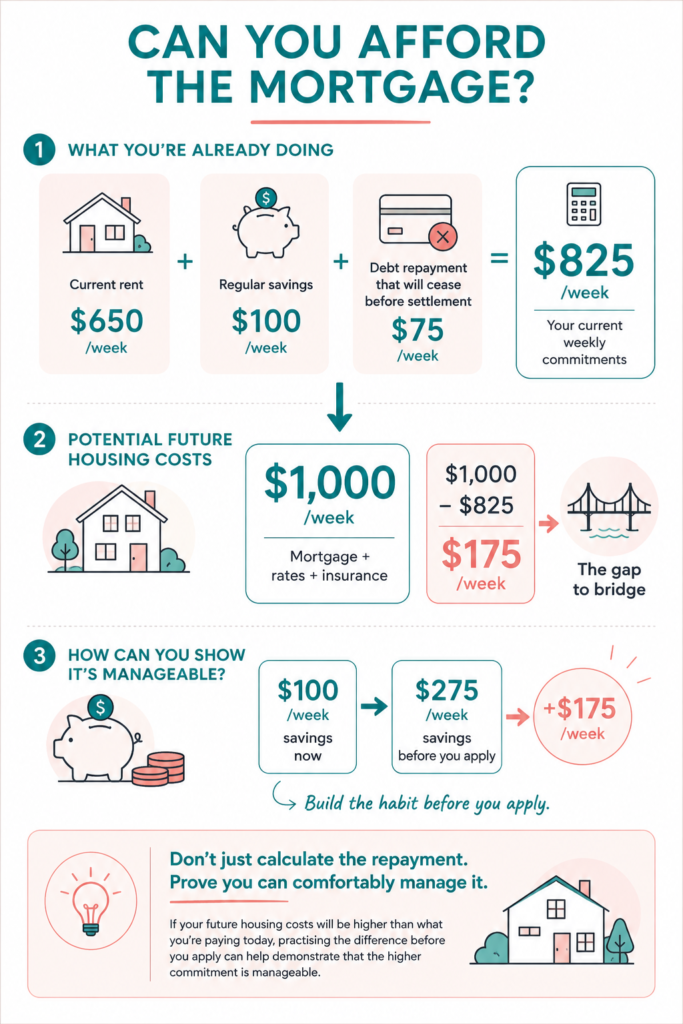
If you’re currently renting and working towards buying, one of the best things you can demonstrate is that you can consistently put money aside.
Even better, if you can regularly save an amount that is similar to the difference between your current rent and your expected future housing costs, you’re starting to demonstrate that the higher cost is manageable.
For example, if you’re currently paying $825 a week in rent/debt repayments/savings and expect your future mortgage, rates and insurance to cost around $1,000 a week, consistently putting aside that difference gives you useful evidence of your ability to manage the higher cost.
It’s not about ticking a magic savings box.
It’s about creating a financial habit that makes sense.
What lenders can look past
This is where I think people can unnecessarily stress themselves out.
You don’t need to panic-clean your bank account because you’re thinking about applying for a mortgage.
A one-off holiday.
A big birthday purchase.
A weekend away.
A few dinners out.
A new appliance.
A $7 coffee.
These things don’t automatically make you a bad mortgage applicant.
If the overall picture is strong, lenders can generally look at discretionary spending in context.
The goal isn’t to pretend you never spend money.
The goal is to show that your spending is sustainable.
The best thing you can do before applying
Don’t wait until you’re ready to submit an application to start looking at your bank statements.
Ideally, talk to a mortgage adviser before you apply.
This is particularly useful if you have something outside the standard picture, because different banks have different lending criteria.
That gives you time to identify anything that could potentially cause questions and, more importantly, make meaningful changes.
Trying to create perfect statements for one month isn’t the answer.
If you have regular overdrafts, BNPL accounts, high credit card balances or inconsistent savings, it’s much better to understand the issue and work on it over a few months.
And if your credit cards are paid in full each month, that’s a very different picture from carrying a growing balance.
Where possible, reducing unnecessary credit card debt and lowering limits can also strengthen your overall position
My practical checklist before you apply
Download your last 90 days of bank statements and look at them as if you were the lender.
Ask yourself:
Income
Is my income consistent?
Are there any unusual deposits I would need to explain?
Spending
Am I regularly spending everything I earn?
Are there subscriptions or expenses I've forgotten about?
Is my discretionary spending sustainable?
Debt
Do I have BNPL accounts I don't really need?
Am I carrying credit card balances?
Am I regularly using overdrafts or credit to get through to payday?
Conduct
Are my bills and repayments being paid on time?
Are there any dishonours, missed payments or cash advances?
Are there transactions I would need to explain?
Savings
Am I consistently putting money aside?
Could I demonstrate that I can manage the difference between my current rent and future housing costs?
Do I have cash available for the costs that come with buying, rather than relying entirely on my deposit?
You don’t need every answer to be perfect.
But knowing the answers before you apply can make the whole process much less stressful.
One of the smartest things you can do: start early
This is the bit I really want first-home buyers to take away.
Don’t panic-clean your accounts just before applying.
If there are things that need improving, give yourself time to improve them properly.
Three months of consistently good account conduct is much more meaningful than suddenly cutting out every coffee two weeks before applying.
And sometimes the right answer isn’t “spend less”.
It might be paying down a credit card, closing unused BNPL accounts, stopping an overdraft cycle, building a consistent savings habit or simply understanding what your actual future housing costs will be.
There’s no universal checklist because every borrower’s situation is different.
That’s why getting advice early can be so useful.
A few questions I get asked all the time
Do banks look at every transaction on my bank statements?
Lenders will review your statements as part of their assessment, but they’re generally looking at the overall financial picture rather than judging individual everyday purchases.
Will buying takeaway stop me getting a mortgage?
No. Occasional takeaway or restaurant spending isn’t automatically a problem. What matters is whether your overall spending is sustainable and compatible with the amount you’re applying to borrow.
How far back do banks look at bank statements?
Typically three months, but if applying with your own bank they do have access to a longer period. It can be better to prepare your accounts well before you apply rather than focusing on trying to make one short period look perfect.
Should I close my Afterpay or Zip before applying?
If you don’t need the accounts, reducing unnecessary BNPL commitments can be helpful. But don’t make changes without considering your wider situation. If you’re planning to apply soon, it’s worth getting advice on what will make the most difference.
How much should I have in savings before applying for a mortgage?
There isn’t one magic number. Your deposit is important, but having some cash available for the costs of buying and demonstrating a consistent savings habit can also strengthen your position.
Should I stop spending before applying for a mortgage?
No. You don’t need to stop living your life. The goal is to understand your spending, remove unnecessary commitments and demonstrate that your finances are sustainable.
Your bank statements don't need to be perfect.
They need to tell a story a lender can understand and be comfortable with.
So don’t panic about the occasional coffee, takeaway or shopping trip.
Instead, focus on the things that actually matter: consistent account conduct, manageable debt, sustainable spending and regular savings.
And ideally, start working on those things before you’re ready to apply.
The earlier you understand what a lender is looking for, the more time you have to strengthen your position — and avoid nasty surprises when you’re finally ready to buy.
If you’re not sure what your own bank statements are saying to a lender, that’s exactly the sort of thing I’d recommend reviewing before you apply.
And, if you’re not sure whether you’re actually ready to buy, start with 5 signs you might be closer to buying your first home than you think.
Not planning to buy just yet? That’s actually the best time to review your position.
If you’re wondering what your bank statements, spending and savings habits might look like to a lender, get in touch. We can work out what’s worth changing now — so you’re in a stronger position when you’re ready to apply.