In this article you’ll learn
- What actually determines how much you can borrow
- Why online calculators give you very different answers
- Why borrowing capacity isn’t the same as your comfortable budget
- The small changes that can sometimes improve your borrowing position
- How to work out what borrowing amount makes sense for you
5-minute read
How much can you really afford to borrow?
How much can I borrow to buy my first home?
It’s one of the first questions I get asked by first-home buyers.
And it’s completely understandable.
You want to know what price range you should be looking at, whether the homes you like are actually within reach, and whether you’re closer to buying than you thought.
The problem is that there isn’t one simple answer.
One of the most common questions I see in the Kiwi First Home Buyers Facebook group is someone posting their income, savings and debts and asking:
“How much do you think I could borrow?”
Then the replies start rolling in.
One person says $500,000. Someone else says $600,000. Someone suggests trying a bank calculator. Another says they should pay off their credit card first.
Suddenly, you have five different answers and no idea which one is actually right.
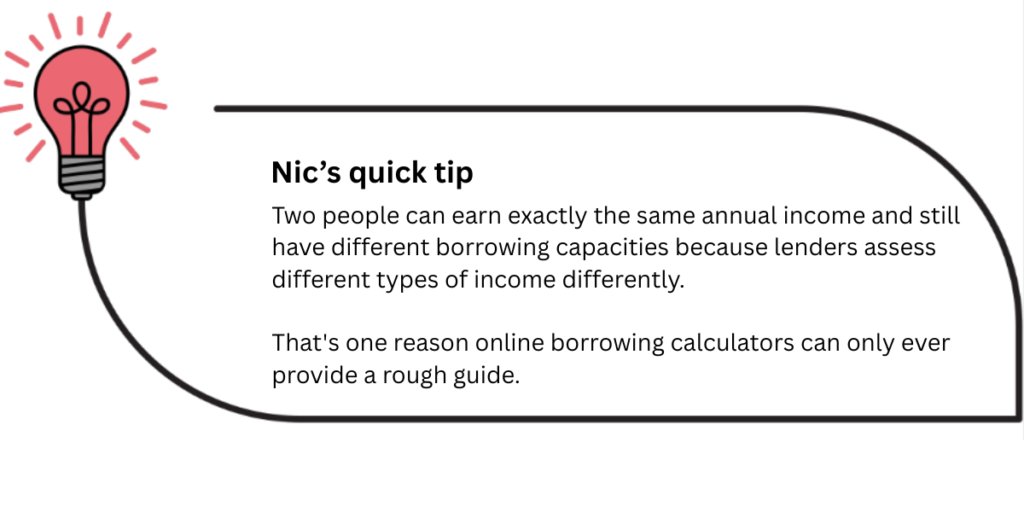
The truth is, borrowing capacity isn’t based on your income alone.
Banks look at your income, debts, spending, dependents, deposit, the type of income you earn, the loan term and their own lending criteria.
And there’s another question that’s just as important:
Even if a bank will lend you that much, is it an amount you actually want to borrow?
That’s where things get interesting.
The short answer
How much you can borrow depends on your overall financial position — not just your income.
Banks will generally look at your income, existing debts, living expenses, dependents, deposit, loan term and the type and reliability of your income. Different lenders can also assess the same situation differently, which is why online calculators can produce very different results.
But there’s an important difference between what you can borrow and what you can comfortably afford to borrow.
The goal isn’t simply to find the biggest number a bank might approve.
It’s to work out a borrowing amount that fits your budget, your lifestyle and your longer-term plans.
Why this matters
Knowing your borrowing capacity is useful.
Knowing what that borrowing will actually feel like each week is even more useful.
A bank may be prepared to lend you a certain amount, but that doesn’t automatically mean it’s the right amount for you.
Your mortgage is going to be one of your biggest financial commitments, so it’s worth thinking about what you want your life to look like alongside it.
Do you still want to be able to travel? Keep building savings? Have room for unexpected expenses? Make extra repayments when you can?
This is why I like to look at affordability as well as borrowing capacity.
Rather than simply asking, “What’s the biggest loan I can get?”, we’re asking:
“What mortgage can I comfortably live with?”
That might mean borrowing less than your maximum.
Or, it might mean finding ways to improve your position so you can comfortably afford the home you really want.
Either way, understanding the difference gives you a much clearer starting point.
What I see every week
One thing I see all the time is people assuming they need to earn more before they can buy.
But often, income isn’t the problem.
They may already have enough income and enough deposit to support a purchase — they just haven’t worked out how all the pieces fit together yet.
There might be a debt affecting their borrowing capacity more than they realise.
Their income might be able to be assessed differently by another lender.
They might have a deposit that’s smaller than they thought they needed.
Or they may simply be looking at the maximum they could borrow rather than what they’d actually be comfortable repaying.
And this is why I don’t like giving people a single borrowing number without looking at the bigger picture.
My job isn’t to find the biggest mortgage you can possibly get.
It’s to help you understand what’s possible, what’s affordable and what could get you into your first home sooner.
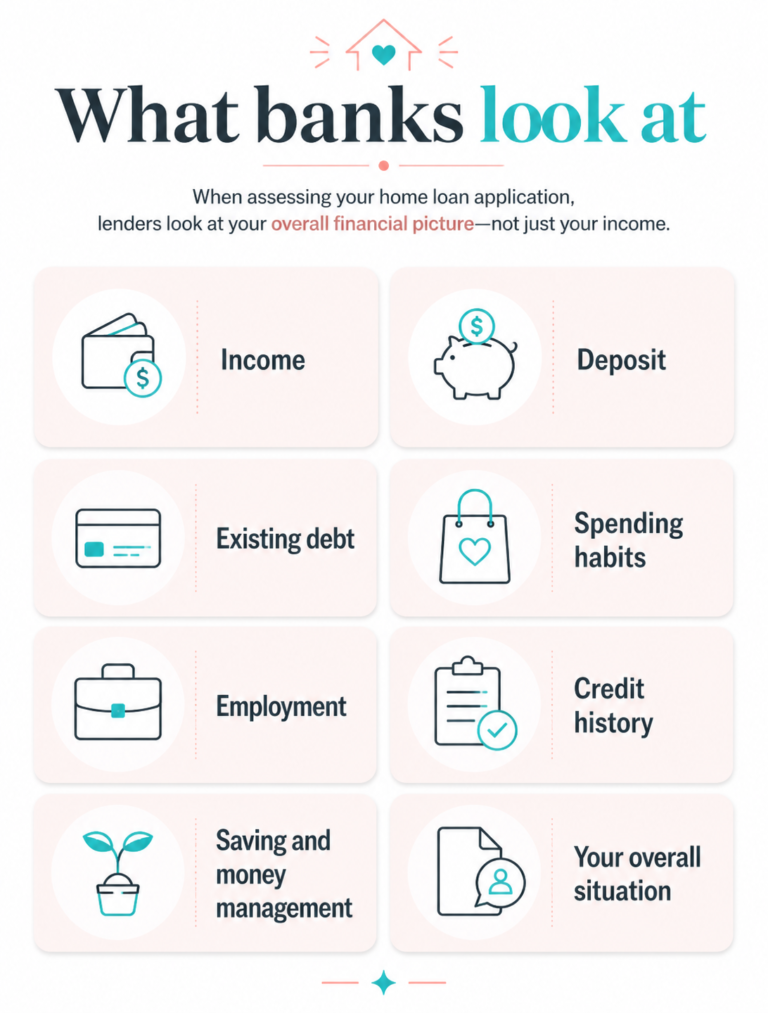
1. Your income is only part of the picture
Your income is obviously an important part of working out how much you can borrow, but it’s not as simple as putting your salary into a mortgage calculator.
We can often use a wide range of income sources when assessing a home loan, but it depends on the type of income, how long you’ve been receiving it, how consistent it has been and the lender you’re approaching.
PAYE income is generally the most straightforward to assess. If you’re permanently employed and receiving a regular salary, it’s usually fairly easy for a lender to establish what income can be used.
But your income doesn’t have to look like a standard PAYE salary to be considered.
Depending on your circumstances, lenders may be able to consider things like:
- Overtime
- Bonuses or commission
- Casual income
- Fixed-term employment
- Self-employed or business income
- Boarder income
- Working for Families or other assistance
- A confirmed pay rise that hasn’t started yet
There can be different requirements around each type of income. For example, a lender may want to see a history of receiving overtime or commission, while a self-employed applicant may need to have been in business for a certain period.
There can also be options if your circumstances are about to change.
For example, if you’ve received confirmation of a pay rise that hasn’t started being paid yet, a lender may be able to consider the increased income.
And being on maternity or parental leave doesn’t automatically mean you can’t get a home loan. If you have a confirmed return-to-work date and your employment and income are expected to continue, there may still be options.
So when you’re asking, “How much can I borrow?”, don’t just look at your base salary.
The type, history and sustainability of your income — and the lender assessing it — can all make a difference.
2. Your existing debt can have a bigger impact than you think
This is one of the things that can surprise first-home buyers the most.
Existing debts all have an impact on what you can borrow — and sometimes the impact is much bigger than you’d expect.
Your existing commitments might include:
- Student loans
- Credit cards
- Car loans
- Personal loans
- Buy Now Pay Later accounts
- Existing mortgages
- Other finance commitments
The important thing is that lenders don’t all assess debt in exactly the same way.
It’s not always how much you owe that matters
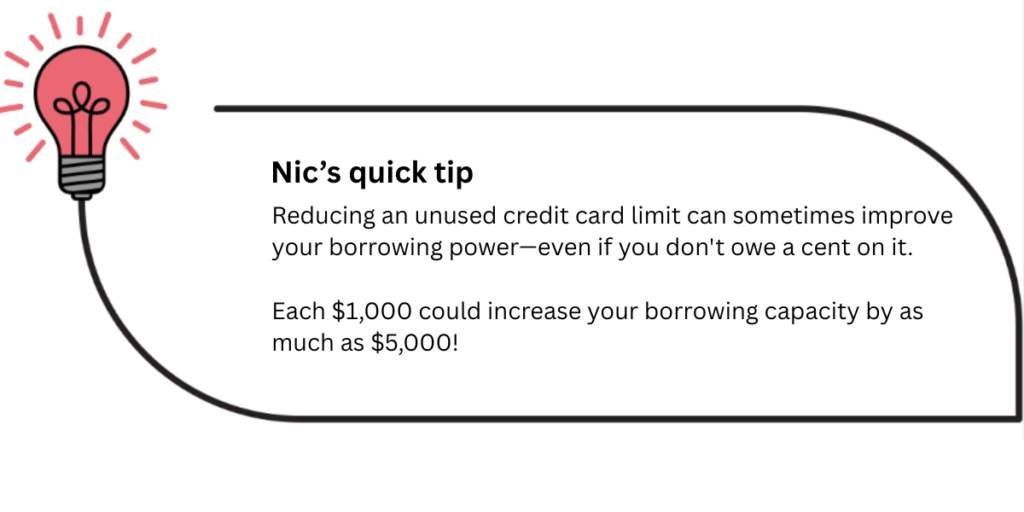
With a credit card, for example, the lender may look at your credit card limit, rather than simply the amount you currently owe.
So if you have a $10,000 credit card limit but only $500 owing, that $10,000 limit can still affect the assessment.
Student loans can also have an impact.
Your student loan repayment is linked to your income, so for a higher-income earner, the required repayment can be significant.
In some situations, if the remaining student loan balance is relatively low and you have enough spare funds or deposit available, it may make sense to consider paying it off before applying for your mortgage.
But that’s not something I’d recommend doing automatically.
Using $10,000 of your deposit to clear a student loan isn’t necessarily the right move if you then don’t have enough deposit left for the property you want to buy.
This is where getting the right advice matters.
We can look at the overall picture and work out whether paying off a debt, reducing a credit card limit or keeping those funds available for your deposit is likely to put you in the stronger position.
The repayment can matter more than the balance
For many types of debt, the monthly repayment is particularly important because the lender needs to allow for that commitment when assessing whether you can afford a new mortgage.
This is why a debt that looks relatively small on paper can sometimes have a surprisingly large impact on your borrowing capacity.
If a debt is going to be completely repaid before you purchase, there may also be ways to structure your application around that.
For example, in some circumstances a pre-approval may be sought on the basis that a particular debt will be cleared before final approval.
The key is understanding which debts are affecting your borrowing capacity, by how much, and what — if anything — is worth changing before you apply.
3. Your spending and affordability matter too
It’s not enough for a lender to see that you earn enough money to make the mortgage repayments.
They also need to be comfortable that you can afford the mortgage alongside the rest of your life.
Lenders will look at things such as:
- Food and takeaways
- Utilities
- Transport costs
- Insurance
- Childcare
- Personal expenses
- Other regular household costs
This is one of the reasons I don’t recommend relying on an online calculator to work out your budget.
A calculator might tell you what you could potentially borrow, but it doesn’t really show you what that mortgage will feel like in your day-to-day life.
One of the ways I like to work this out with clients is to look at what they’re already doing with their money.
For example:
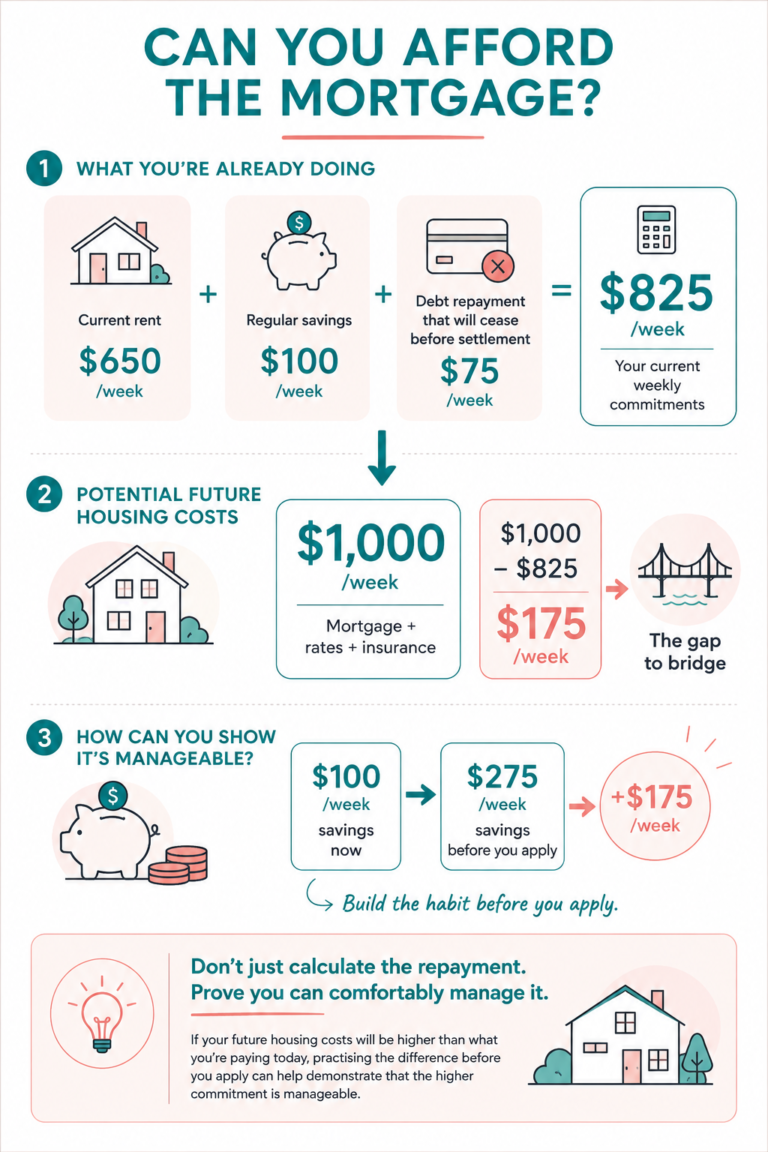
Current rent + regular savings + debt repayments that will disappear = a useful starting point for your future housing costs.
We can then compare this with potential mortgage repayments, rates, insurance and other costs of owning a home.
It’s also worth being mindful of your spending in the lead-up to an application. Good budgeting can help you understand what you can comfortably afford and put you in a stronger position when you’re ready to apply.
You don’t need to stop enjoying life just because you’re planning to buy a house.
But being intentional with your money can make a difference — both to your borrowing position and to how comfortable you’ll feel once you own your home.
The goal isn’t just to get the biggest loan approved. It’s to make sure the repayments fit comfortably into your life.
4. Your deposit can affect more than just how much you need to borrow
Your deposit is obviously important because the more you have available, the less you need to borrow.
But your deposit can also affect the lending options and interest rates available to you, which can change your repayments and the overall cost of borrowing.
This is one reason why I don’t automatically tell first-home buyers, “Just keep saving until you have 20%.”
For some buyers, getting to 20% is absolutely the right strategy.
For others, waiting several more years to reach that number may not be the best option.
There are lending options available for eligible buyers with smaller deposits, including the Kāinga Ora First Home Loan, which can allow eligible first-home buyers to purchase with a minimum 5% deposit.
In the right situation, using a lower-deposit option can allow you to get into the market sooner rather than waiting years to build a larger deposit.
Of course, there are trade-offs to consider, including the interest rate, lending criteria and any additional costs.
That’s why I look at the overall strategy rather than simply saying, “More deposit is always better.”
Once you’re buying, I also like to think beyond day one.
A suitable loan structure can help you make the most of your repayments and build equity over time, which can give you more options as your circumstances change.
Your deposit isn’t just a number you need to reach. It’s one part of the strategy for getting you into the right home, with the right loan, at the right time.
5. The lender you approach can make all the difference
Here’s something that can make the whole “How much can I borrow?” question even more confusing:
There isn’t one universal borrowing calculator used by every bank.
Different lenders have different lending policies, affordability assessments and approaches to the things that can affect your borrowing capacity.
They may assess different types of income differently.
They may have different approaches to existing debts.
They may treat boarder income differently.
They may have different requirements around employment history, dependents or expenses.
And they can all come up with different answers for the same person.
This is why I sometimes see first-home buyers who have put their details into two or three bank calculators and come away completely confused.
One says they can borrow $500,000.
Another says $550,000.
Another says $600,000.
So which one is right?
The answer is: it depends.
Your borrowing capacity isn’t a universal number that exists independently of the lender.
It’s based on your overall financial position and how that particular lender assesses it.
That’s why getting advice before you start house hunting can be so valuable.
Instead of guessing which calculator is closest to reality, we can look at your full financial position, understand which lenders may suit you and work out what your realistic borrowing range could look like.
And importantly, we can also talk about whether that borrowing amount is actually comfortable for you.
The biggest number isn’t necessarily the best number. The right number is the one that works for your situation.
6. So, how much should you actually borrow?
This is probably the most important part of the whole conversation.
Just because a bank is prepared to lend you a certain amount doesn’t mean you need to borrow that much.
Your borrowing capacity tells us what may be possible based on your financial position and a lender’s assessment.
Your budget tells us what you’re actually comfortable spending.
And those two numbers can be quite different.
When I work with clients, I don’t just want to know the maximum amount a bank might approve. I also want to understand what their repayments would look like in real life.
One of the simplest ways to start is by looking at what you’re already doing with your money.
For example, let’s say you’re currently paying:
$650 a week in rent
+$100 a week into savings
+$75 a week towards a debt that will be repaid before you buy
= $825 a week
That gives us a useful starting point.
We can then look at what your potential mortgage repayments could be, along with rates, insurance and the other costs that come with owning a home.
It’s not as simple as saying, “You’re already spending $825 a week, so you can afford an $825 mortgage.” But it can show us if your housing costs will be $1000 a week then ideally you need to be able to show the ability to save or reduce costs by an additional $175 a week.
And it helps us understand your current financial position and what a change to home ownership could look like.
And importantly, we can talk about what you want your life to look like after you buy.
Do you still want to travel? Keep building savings? Have room for unexpected expenses? Are there changes coming in the next few years?
These things matter.
You don’t have to buy your forever home first
I also think first-home buyers can put a lot of pressure on themselves to buy the biggest or nicest home they can possibly afford.
But your first home doesn’t have to be your forever home.
An entry-level property that you can comfortably afford can be a stepping stone.
You can build equity, pay down your mortgage, increase your income and allow your circumstances to change. Then, when the time is right, you may have more options to move up.
Sometimes the smartest first-home purchase isn’t the one that stretches you to your absolute limit.
It’s the one that gets you onto the property ladder while still allowing you to enjoy your life.
So, what should you actually borrow?
There isn’t a magic percentage of your income or one calculator that can tell you the answer.
It comes down to your individual circumstances, your goals and how comfortable you are with the repayments.
My job isn’t to tell you the biggest mortgage you can get.
It’s to help you understand:
What can you borrow?
What could you comfortably afford?
And what could get you into your first home sooner?
Because getting approved is only part of the journey.
I want you to move into your first home feeling excited about owning it — not wondering how you’re going to afford to live in it.

Real buyer story
One recent client came to me thinking her options were limited to an apartment.
She had a decent income and had made a good start on her deposit, but she also had some existing commitments that were affecting her borrowing capacity.
Rather than simply telling her the maximum she could borrow, we looked at the bigger picture.
We worked through her debts, her expenses, her deposit and what her repayments would actually look like.
With a few changes to her position, we were able to improve her borrowing capacity.
That opened up the possibility of looking at townhouses rather than just apartments.
And that’s one of my favourite parts of this job.
The goal isn’t always to find a way to borrow more.
Sometimes it’s simply helping someone understand what is actually possible — and what they need to do to get there.
What could improve your borrowing capacity?
Not being quite there today doesn’t necessarily mean you’re years away.
Sometimes the difference between “not quite” and “yes” isn’t another $20,000 of income. It can be one or two changes to the position you already have.
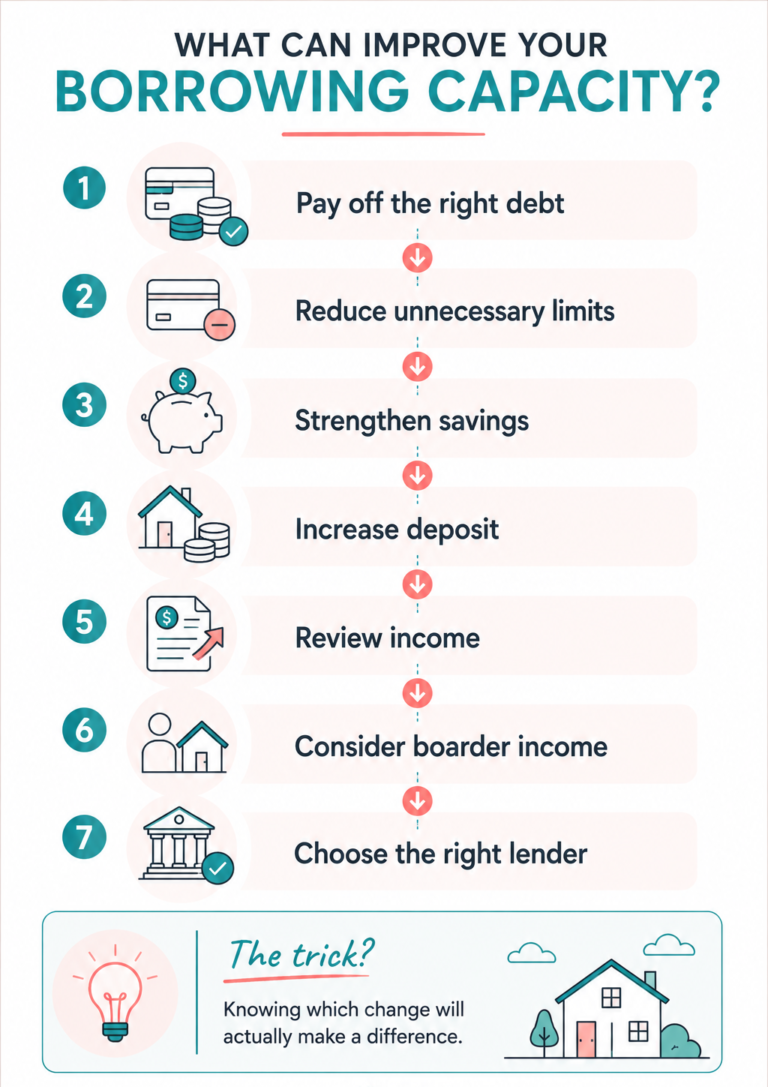
Depending on your circumstances, that could include:
- Paying off a particular debt – especially if the repayment is having a significant impact on your affordability.
- Reducing a credit card limit – remember, the limit can matter even if you don’t owe much on the card.
- Changing the timing of your purchase – sometimes waiting a few months for a particular debt to be cleared or for your income history to strengthen can make sense.
- Improving your savings – showing that you’re consistently managing your money well and building your deposit can strengthen your overall position.
- Increasing your deposit – a larger deposit can reduce the amount you need to borrow and may open up different lending options and better interest rates.
- Reviewing your expenses – understanding where your money is going can help you work out what you can realistically afford and where there may be room to improve.
- Considering boarder income – where appropriate, this can potentially make a significant difference to what you can borrow.
- Looking at a different lender – different lenders have different policies and ways of assessing income, expenses and debt.
But here’s the important part:
The trick is knowing which change will actually make a difference.
It’s very easy to hear generic advice like “pay off your debt”, “save more” or “cut your spending” and spend the next six months doing exactly that.
But what if you’ve been paying off the debt that has the smallest impact on your borrowing capacity?
Or you’ve been holding off buying because you think you need another $20,000 in your deposit, when a different lending option could have allowed you to buy sooner?
Or you’ve reduced your spending dramatically, but your real constraint is actually your income or the type of income you earn?
This is why I like to look at the numbers first and then work out what is actually worth changing.
You don’t need to change everything. You need to focus on the changes that are most likely to move the needle.
Sometimes the fastest path to buying isn’t earning more.
It’s making a few smart changes to the position you already have.
Common mistakes first-home buyers make
 Assuming the online calculator is accurate.
Assuming every bank will lend the same amount.
Looking at the maximum borrowing amount instead of the comfortable amount.
Paying off the wrong debt before an application.
Assuming a huge student loan automatically rules them out.
Assuming boarder income is always a given to boost what you can borrow.
Increasing their deposit without checking whether something else is actually holding their application back.
Falling in love with a house before working out their realistic budget.
That last one is a big one.
It’s much easier to adjust your expectations before you fall in love with the house.
What if this is you?
“I earn a decent income but have a lot of debt.”
There may be a smarter way to prioritise what you repay.
“I have a good deposit but I’m not sure what I can afford.”
Let’s work backwards from a comfortable repayment rather than starting with the maximum loan.
“I’m self-employed, casual or fixed-term.”
Your income may still be usable — it depends on your circumstances and the lender.
“I have a student loan.”
Don’t assume it automatically rules you out. The impact depends on your overall position.
“I could get a boarder.”
Boarder income can help in some situations, but it isn’t as simple as adding the boarder’s rent to your income.
“The bank calculators are giving me different answers.”
That’s exactly why personalised advice can help.
*Your first home faster action*
Don’t just calculate your maximum borrowing. Calculate your comfortable borrowing.
Before you start looking at properties, work out:
- What you're paying in rent now
- What you're currently saving
- Which debt repayments would disappear
- What your potential mortgage repayment could be
- What rates and insurance might cost
- What you'd still want left over each week for normal life
Then get your position professionally assessed.
Knowing your numbers before you start house hunting can save you a lot of wasted time — and stop you falling in love with a house that’s outside your comfortable budget.
A few questions I get asked all the time
How do banks calculate how much I can borrow?
There isn’t one simple formula that every bank uses.
Lenders look at your income, existing debts, living expenses, deposit, dependants, loan term and the type and reliability of your income. They then apply their own affordability assessments and lending criteria.
This is why two banks can sometimes assess the same person differently.
And remember: the amount you can borrow isn’t necessarily the amount you should borrow.
How much does a student loan affect my borrowing capacity?
A student loan can affect your borrowing capacity because the required repayment is taken into account when a lender assesses affordability.
The impact depends on factors such as your income and remaining balance.
If your student loan balance is relatively low, it may sometimes make sense to repay it before applying for a mortgage — but don’t automatically use your deposit to clear it without checking the numbers first.
How much does a credit card affect how much I can borrow?
This can be a surprising one.
Lenders may look at your credit card limit rather than the amount you currently owe.
So a $10,000 credit card limit can affect your borrowing capacity even if you only owe $500.
If you don’t need the full limit, reducing it may improve your borrowing position. It’s worth checking the potential impact before making changes.
Can boarder income be included when applying for a home loan?
Potentially, yes.
Some lenders can include boarder income when assessing borrowing capacity, and in the right circumstances it can make a significant difference.
However, the amount that can be used and any property or household requirements will depend on the lender and your circumstances.
If you’re relying on boarder income to make the numbers work, check how the lender will treat it before you buy.
Can I get a home loan if my income is casual or fixed-term?
Yes, potentially.
Casual or fixed-term employment doesn’t automatically rule you out.
The lender may consider factors such as how long you’ve been receiving the income, how consistent it has been and what evidence you can provide.
Different lenders can take different approaches, so finding the right fit can be particularly important.
Why do different bank calculators give me different results?
Because different lenders can assess your situation differently.
Each lender has its own lending criteria, affordability assessment and approach to income, expenses, debts and other factors.
Online calculators are useful as a general guide, but they can’t always capture the detail of your individual circumstances.
So if three calculators give you three different borrowing amounts, don’t panic.
It doesn’t necessarily mean one is wrong. It means your borrowing capacity isn’t one universal number.
Ready to work out what you can really afford?
If you’re wondering how much you can borrow, you don’t need to guess — and you don’t need to rely on whichever online calculator gives you the biggest number.
A personalised assessment can help you understand where you stand today, what you could comfortably afford and whether there are any changes that could improve your position.
Whether you’re ready to buy now or still working towards your goal, knowing your numbers gives you something much more valuable than a borrowing limit.
It gives you a plan.
If you’re not quite ready yet, that’s okay too. Knowing what needs to happen next can help you get there sooner.
Book a First Home Readiness Review and let’s work out your next best step.
Want the full roadmap?
Download the First Home Faster Toolkit for a step-by-step guide to getting from “maybe one day” to buying your first home.
The goal isn’t to find the biggest mortgage you can get. It’s to find the mortgage you can comfortably live with.