In this article you’ll learn
- Why a bank might decline your mortgage application
- The difference between “not yet” and “not possible”
- What you can do to improve, rework or redirect your application
- Why another lender may assess your situation differently
5-minute read
The bank said no. Can I still get a mortgage?
One of the hardest conversations I have is with people who have already been told “no” by a bank.
They often come to me thinking their dream of owning a home is over.
But a decline doesn’t always mean you can’t buy a home.
Sometimes the answer is “not yet”. Sometimes another lender may be able to work with your circumstances. And sometimes the application needs to be looked at differently so the lender can properly understand your financial position.
The important thing is understanding why the bank said no and what you can do about it.
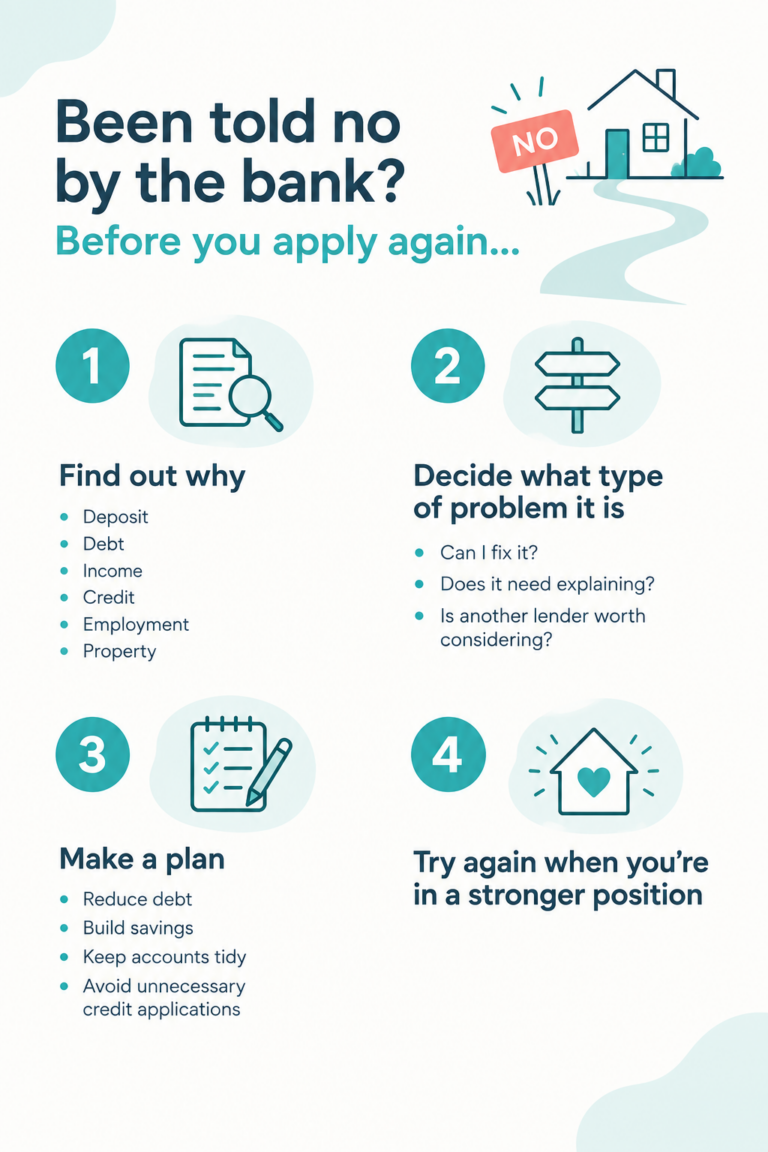
First, find out why you were declined
Before making another application, you need to understand what stopped the first one from working.
Was it your deposit?
Your income?
Existing debt?
Employment history?
Recent credit enquiries?
Your spending?
The type of property you’re buying?
Or something about the way your financial position has been presented?
The reason matters because the solution depends on it.
A decline isn’t always about not earning enough or not having enough deposit. Sometimes it’s about how your circumstances fit within a particular lender’s assessment.
And sometimes there are several things contributing to the outcome.
Sometimes the application needs a closer look
I’ve worked with clients who couldn’t get the borrowing they needed when they approached a bank directly.
In one case, the clients had casual and seasonal income. On the surface, that can make income look less straightforward to a lender.
We were able to show that their income had actually been consistent over several years, provide context around how the income was earned, demonstrate that some personal debts had already been cleared and make sure the lender understood their relatively low level of expenses.
The result was a much clearer picture of their overall position.
The income hadn’t suddenly increased.
We simply made sure the lender had the information and context needed to properly assess it.
This is one of the reasons I don’t think a decline should automatically be viewed as a final answer.
Sometimes the question is whether the lender has the right information to make a decision.
A real example: the first answer wasn't the final answer
I recently worked with clients who came to me with a property already under offer. It was a new build due to be completed later in September, so there was a bit of urgency around getting the lending sorted.
They had already approached a couple of banks directly and had been given borrowing figures ranging from around $495,000 to $630,000.
On the face of it, they had already done the right thing — they’d spoken to banks and had some answers.
But there was still more to understand.
We worked through their income, existing commitments and overall financial position, then looked at how the application could be presented and which lender was the best fit.
We were ultimately able to get approval for $643,500 with one of the banks they had already approached, just enough to allow them to settle.
The important point isn’t that one bank was “right” and another was “wrong”.
It was that the first answers weren’t necessarily the end of the conversation.
Sometimes you need to step back, understand how the lender is assessing the application and work out whether there is another way forward.
Sometimes the lender isn’t the right fit
There are also situations where the application itself may be fine, but a particular lender simply isn’t able to accommodate it.
For example, I have a client with Australian income where one lender would only consider the application at a much lower LVR.
They had a 10% deposit, but that particular lender wasn’t able to lend at the level they needed.
Rather than changing the client’s circumstances, we changed the lender.
Another lender was comfortable with the situation, and the application could move forward.
This is where understanding different lender policies can make a real difference.
But it’s important to distinguish this from simply sending an application to every bank you can find.
You need to know which part of the application isn’t working and why before deciding what to do next.
And sometimes the answer really is “not yet”
Not every decline can be solved by finding another lender.
Sometimes your financial position genuinely needs some work first.
I’ve had a client whose borrowing capacity was being affected by a number of smaller personal debts.
Rather than trying to find a lender who would simply overlook them, the focus was on clearing those debts and getting her into a much tidier financial position.
Once those commitments were gone, her borrowing capacity improved and she was in a stronger position to move forward.
That’s what I mean when I say “not yet” is different from “never”.
You might not be ready to buy today.
But if you know exactly what needs to change, you can work towards being ready.
There can be things you simply wouldn't know about
This is another reason getting advice early can be valuable.
There are lender requirements that aren’t necessarily obvious when you’re applying directly.
For example, some lenders have specific requirements around how long you’ve been in your current role when you’re buying with a low deposit.
You might have a good income and enough deposit, but if you’ve only recently started your current role, that particular lender may not be comfortable with the application.
There can also be issues around recent credit enquiries, gambling transactions, unexplained transfers between accounts or other activity that prompts questions during an assessment.
None of this means you need to have “perfect” finances.
It means it’s useful to understand what a lender is likely to look at before you apply.

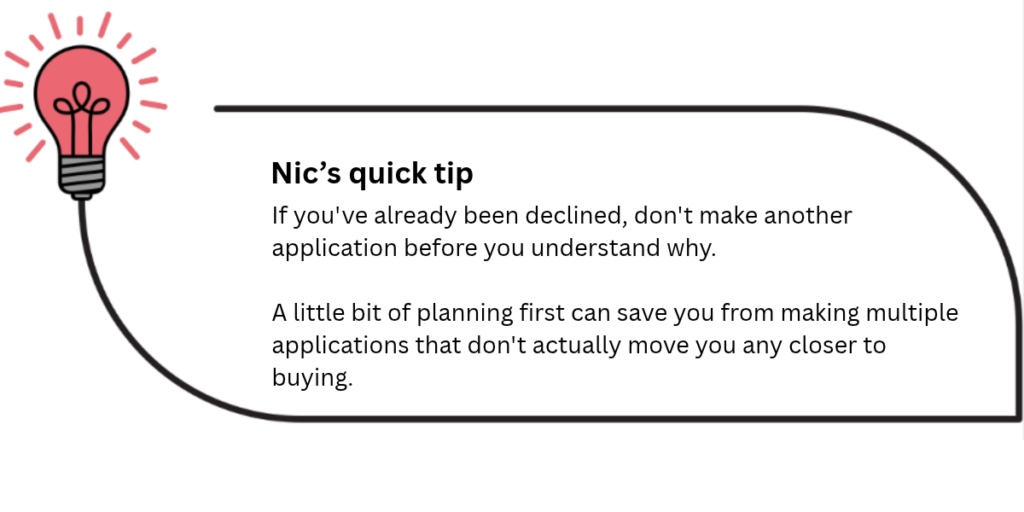
Don't just make another application
If you’ve been declined, it can be tempting to immediately apply somewhere else.
I understand why.
You want an answer, and you want to keep moving.
But another application without understanding the first decline can simply give you another “no” — and potentially create more credit enquiries along the way.
My approach is to go back to the feedback and work out exactly what is standing in the way.
Then we create an action plan.
That might mean:
Reducing or clearing some debt
Avoiding further credit applications
Building up your deposit
Keeping your accounts tidy and straightforward
Waiting until you’ve been in your role for long enough
Looking at a different lender
Looking at a different purchase price
Providing more information to support your income
Or simply giving things some time
The goal is to know what needs to happen before we try again.
I've also seen a lender say no because something doesn't make sense on paper
One client I’m working with is settling on their first home very soon.
They’re buying on their own, although they’re in a relationship, and there had been money moving between their accounts and their partner’s accounts.
To the original lender, the movement of funds didn’t make sense and raised questions around the application.
That didn’t necessarily mean there was anything wrong with the client’s financial position.
It meant we needed to find a lender where the circumstances could be properly explained and assessed.
We were able to do that, and the client was approved elsewhere without the same issue becoming a roadblock.
Sometimes it’s about the numbers.
Sometimes it’s about the policy.
And sometimes it’s about making sure the lender understands what’s actually happening.
*Your first home faster action*
If you’ve been told no, write down the reason the bank gave you.
Then ask yourself:
Is this something that can change?
If the answer is yes, that’s where your plan starts.
If you’re not sure why the application didn’t work or what your next step should be, that’s exactly the sort of situation I help first-home buyers work through.
You’ve been told no. That doesn’t necessarily mean you have to give up. Let’s work out what’s actually standing in your way.
A few questions I get asked all the time
Can I still get a mortgage if a bank has declined me?
Yes, potentially. A decline from one lender doesn’t automatically mean you can’t get a mortgage. It’s important to understand why the application was declined first, as you may need to fix something, provide more information, or consider whether another lender is a better fit.
Why would a bank decline my home loan application?
There are a number of reasons, including your deposit, income, existing debts, expenses, employment history, recent credit applications, credit history or the property you’re looking to buy. The reason for the decline usually determines what your next step should be.
Should I apply to another bank if my mortgage is declined?
Not necessarily. Making multiple applications without understanding the original decline can create more credit enquiries and may not solve the underlying issue. It’s usually better to work out why you were declined first and then decide whether to fix, rework or redirect the application.
How long should I wait before applying for a mortgage again?
It depends on why you were declined. Sometimes you can make changes and try again relatively quickly. In other situations, it may make sense to spend three to six months reducing debt, building your deposit, keeping your finances tidy or allowing your employment history to strengthen before reassessing.
Can a mortgage adviser help if my bank has already said no?
Yes. A mortgage adviser can help you understand why the application was declined, look at which parts of your situation may need to change, and consider whether another lender’s lending criteria may be a better fit. The aim isn’t simply to send another application — it’s to work out the right next step.
So, what should you do if the bank says no?
Don’t panic, and don’t assume it means you’ll never be able to buy.
Start by finding out exactly why the application was declined.
Then ask:
Can this be changed?
Does another lender have a different policy that could work?
Or do I need some time to strengthen my position first?
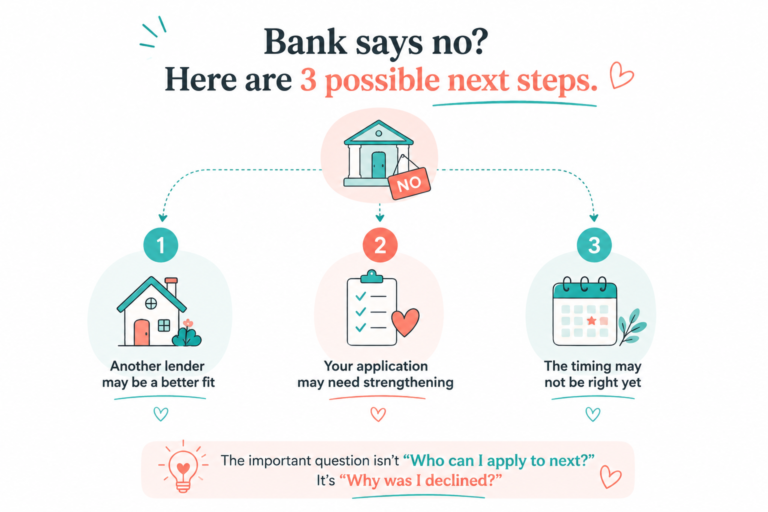
Those questions will usually point you towards one of three paths:
Fix it.
There is something you can change, such as reducing debt, improving your deposit or waiting until your employment position is stronger.
Rework it.
Your circumstances may be workable, but the application needs more context, supporting information or a different structure.
Redirect it.
The particular lender may not be the right fit, but another lender may be able to consider the same circumstances differently.
And sometimes it will be a combination of all three.
The goal isn't just another application
This is probably the most important thing I want first-home buyers to take away.
If you’ve been told no, the goal shouldn’t simply be to find another bank and hope for a different answer.
The goal is to understand why the application didn’t work and create a plan that puts you in a stronger position.
Sometimes that means finding a lender who can work with your circumstances.
Sometimes it means presenting your income or financial position differently.
And sometimes it means taking three or six months to get things tidied up before trying again.
I’ve had clients who thought a decline meant their home ownership plans were over.
It didn’t.
They just needed to understand what was standing in their way and what to do next.
Because “not yet” is very different from “never”.
And if you’re not sure, reach out to talk through.
Related articles
You might also find these helpful:
Do all banks have the same lending rules? Why one bank might say no while another says yes
How much deposit do you really need? Stop saving for the wrong number
5 signs you’re closer to buying your first home than you think
- First Home Faster Toolkit – a practical guide to help you understand what you need to do before applying for a home loan.