In this article you’ll learn
Why understanding your spending can help you save your first-home deposit sooner.
How to create a simple budget that works without giving up everything you enjoy.
What lenders look at when assessing your living expenses and mortgage affordability.
How small, consistent changes can help you prepare financially for your first home.
5-minute read
How a simple budget can help you buy your first home sooner
Whenever I mention the word budget, I can almost see people switching off.
For some, it sounds like spreadsheets, strict rules and saying no to every coffee, takeaway or night out. And if that’s what budgeting means to you, I can understand why it doesn’t sound particularly appealing.
But I don’t believe in budgets that make you miserable.
I believe in understanding where your money goes, making conscious choices and giving your money a purpose. Especially when buying your first home is one of your biggest goals.
You don’t need a complicated spreadsheet or a perfect financial record. You just need a clear picture of what’s coming in, what’s going out and what you want your money to help you achieve.
Here’s how a simple budget can help you get closer to owning your first home.
1. First, understand where your money is going
You might have a rough idea of what you spend each week, but have you ever added it all up?
One of the first things I encourage people to do is look through their recent bank transactions. Not to judge every purchase, but to understand their spending habits.
It’s often the everyday expenses that catch people by surprise. Groceries, takeaways, fuel, subscriptions and all those little purchases that don’t seem like much at the time.
Food spending is a particularly common one. People are often quietly shocked, but not entirely surprised, when they see what they’re spending each month.
And that’s the point. You can’t make informed decisions about your money if you don’t know where it’s going.
Start by reviewing the last 30 days of transactions across your main accounts. Group your spending into essentials, lifestyle spending, debt repayments, regular bills and savings.
You don’t need to track every dollar forever. Even doing this exercise once can highlight opportunities you hadn’t noticed before.
2. Focus on the expenses that make the biggest difference
Once you understand your spending, it’s tempting to start cutting everything you enjoy. But that isn’t necessarily the best place to start.
Instead, look at your recurring expenses.
Think about subscriptions you rarely use, insurance policies worth reviewing, phone plans, regular memberships and debt repayments. These expenses can quietly take a chunk out of your income every month.
For example, freeing up $100 a month and putting it towards your deposit adds up to $1,200 over a year, before any interest earned.
You don’t need to make huge changes overnight. Small adjustments that you can maintain are often more effective than drastic cuts that leave you frustrated after a few weeks.
The goal isn’t to spend as little as possible. It’s to make sure your spending reflects your priorities.
3. Give every dollar a job
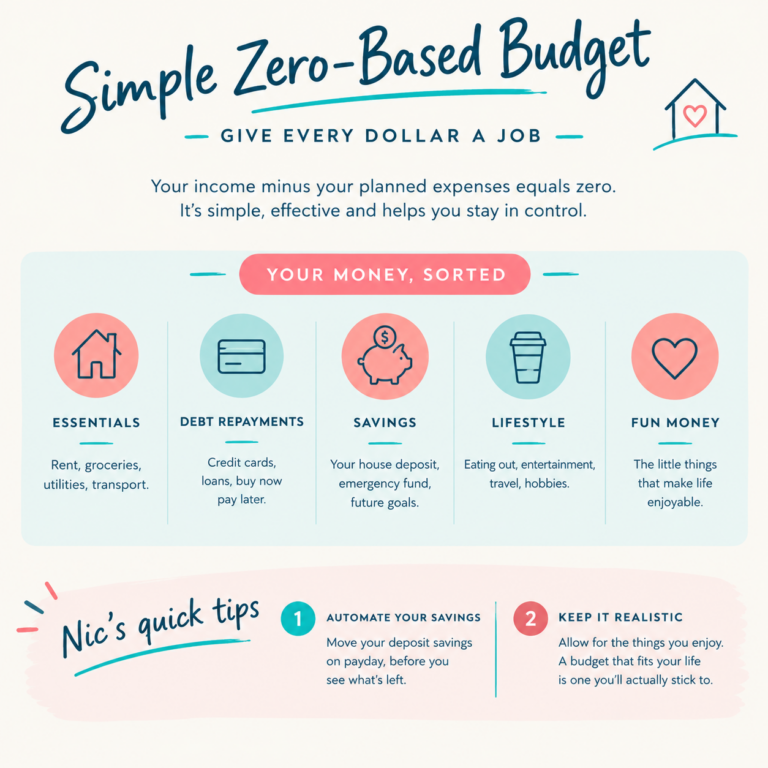
One budgeting approach I particularly like is a zero-based budget.
That simply means giving every dollar of your expected income a purpose before you spend it.
Your money might be allocated to:
Rent or board and household bills.
Groceries, transport and other essentials.
Debt repayments.
Emergency savings and your house deposit.
Entertainment, eating out and spending money.
The idea is that your income minus your planned allocations equals zero. That doesn’t mean you spend everything you earn. Money allocated to savings has a job, too.
For example, if you get paid on Friday, decide in advance how much will go towards your deposit, bills, everyday expenses and fun money. Then move your savings across on payday rather than waiting to see what’s left at the end of the week.
If you wait until the end of the month to save whatever remains, there may not be much left.
Paying yourself first makes saving a deliberate decision rather than an afterthought.
4. Don’t forget to leave room for fun
This is where I think a lot of budgets go wrong.
If your plan relies on never getting a takeaway, cancelling every social event and feeling guilty whenever you spend money on yourself, how long is it realistically going to last?
A good budget needs to reflect your actual life.
Allow yourself some spending money. Plan for birthdays, social occasions and the occasional treat. If you know you have a holiday coming up or a big expense on the horizon, make room for it.
You might decide to reduce takeaway spending rather than eliminate it completely. Or keep one streaming subscription and cancel the two you barely use.
These are your choices to make. The important thing is that they’re intentional.
Progress beats perfection, and a realistic plan you stick to for 12 months is much more useful than an extreme plan you abandon after three weeks.
5. Your budget can help you prepare for a mortgage
Budgeting isn’t just about saving a deposit. It’s also about understanding whether you’re ready to take on the ongoing cost of owning a home.
When you apply for a mortgage, lenders assess your income, existing debts, living expenses and ability to afford the proposed repayments. They’ll generally look at your financial commitments and may review your bank statements to understand your spending patterns.
A budget helps you get familiar with those numbers before you apply.
It can also help you identify expenses or debts that might be worth addressing early, rather than leaving everything until you’re ready to make an offer. And check this out, to see the impact that debt can have on your mortgage application.
One of the most useful exercises is to work out what your future housing costs might look like.
If you’re currently renting, think about your rent, regular savings and what you could realistically afford to put towards a mortgage.
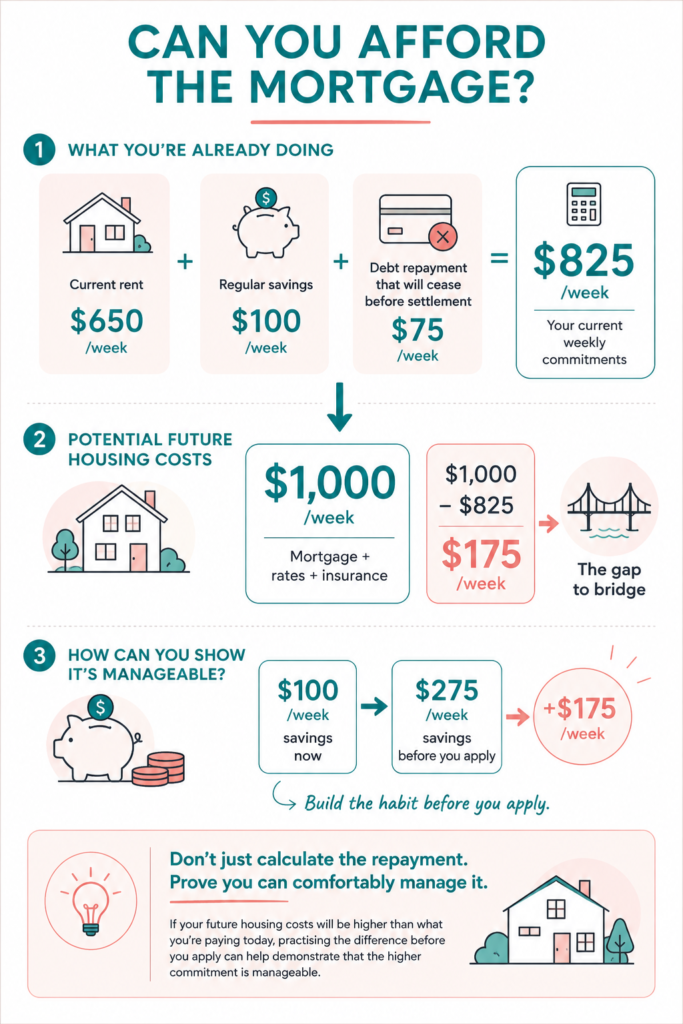
For example, if your rent is $650 a week and you’re consistently saving another $100 a week, you’re already allocating $750 a week towards housing and savings.
That doesn’t automatically mean a mortgage costing $1,000 a week will be affordable. Homeownership also comes with rates, insurance, maintenance and other costs, and lenders assess affordability using their own criteria.
But understanding what you’re already managing gives you a useful starting point for working out what might feel comfortable.
Have a look at this example below too to help show the bank you can manage the future repayments.
6. Start before you’re ready to buy
You don’t need to have found a house or be preparing a mortgage application to start budgeting.
In fact, the earlier you start, the more time you have to build good habits, grow your deposit and make adjustments without feeling rushed.
If you’re still a year or two away from buying, that time is valuable.
You might discover you can save more than you thought. You might identify a debt you want to clear or realise that your current spending habits need a little attention before you take on a mortgage.
And if your numbers don’t quite work yet, that’s useful information, too. It gives you time to work on a plan rather than finding out when you’re ready to buy.
You don’t have to get everything right straight away. You just need to start.
So, do you really need a budget?
You don’t need a fancy budgeting app, a colour-coded spreadsheet or a strict set of rules.
But if buying your first home is a goal, I do think it’s worth understanding your money and having a plan for it.
Start simple. Review your spending, identify one or two changes you could make, set up an automatic savings transfer on payday and make sure your budget leaves room for the things you enjoy.
A budget isn’t about limiting your life. It’s about giving your money a purpose.
And if one of those purposes is helping you buy your first home sooner, every small step in the right direction counts. Check out this guide also to see what banks look at when considering your application.
*Your first home faster action*
Take 30 minutes this week to review your last month’s bank transactions.
Find one recurring expense you could reduce or cancel, and redirect that money towards your house deposit.
You might be surprised by how much difference a small, consistent change can make over time.
A few questions I get asked all the time
Do I need a budget before applying for a mortgage?
You don’t need a formal budget to apply for a mortgage, but understanding your income, expenses, debts and savings can make a big difference. It helps you prepare for lender questions, identify areas for improvement and work out what mortgage repayments you could comfortably manage.
How can budgeting help me buy my first home sooner?
A budget helps you understand where your money is going and identify opportunities to save more towards your deposit. Even small, regular changes can add up over time, particularly when you automate your savings and make them a priority on payday.
Will banks look at my spending when I apply for a home loan?
Yes. Lenders generally assess your living expenses, existing financial commitments and ability to afford the proposed mortgage repayments. They may review your bank statements to understand your spending patterns and check that your declared expenses are realistic.
How much should I save each month for my first home?
This depends on your income, living expenses, existing debts, deposit goal and when you want to buy. Start by reviewing what you currently spend, then work out how much you can realistically set aside each payday. A sustainable savings plan is more useful than setting an ambitious target you struggle to maintain.
What's the best budgeting method for first-home buyers?
The best budget is one you can stick to. A zero-based budget is a useful option because it gives every dollar a purpose, including bills, debt repayments, savings and spending money. You don’t need complicated spreadsheets or strict rules; a simple plan that reflects your lifestyle can be enough to get started.
Should I pay off debt or save for my house deposit first?
It depends on the type of debt, the interest you’re paying, your deposit position and how the debt affects your borrowing capacity. Reducing debt can improve your financial position and potentially increase how much you can borrow, but using all your savings to repay debt may leave you short of a deposit or purchase costs. It’s worth reviewing both options before deciding on a strategy.
Not sure where to start?
If you’re working towards buying your first home but aren’t sure whether your current spending, savings or debts are holding you back, let’s have a chat. Also make sure you downloaded and reviewed my First Home Faster Toolkit.
As your mortgage adviser, I can help you understand where you stand, what lenders may look for and what steps could help you move closer to your goal.
You might be closer than you think.