In this article you’ll learn
- Why a “no” from one bank doesn’t always mean no everywhere
- The ways banks can assess the same application differently
- Which situations can make lender choice particularly important
- What to do if your bank says no
5-minute read
Do all banks have the same lending rules? Why one bank might say no while another says yes
Been told no by your bank? Don’t assume your home-buying plans are over.
One of the biggest myths I hear is:
“If one bank says no, they’ll all say no.”
Thankfully, that isn’t necessarily true.
While all lenders operate within the same broader responsible lending requirements, they don’t all assess applications in exactly the same way. Different banks have different lending policies, assessment methods and appetites for different types of borrowers.
That means a mortgage declined by one bank doesn’t automatically mean you can’t get a mortgage.
Sometimes, it simply means that lender isn’t the best fit for your particular circumstances.
Different banks have different lending criteria
This comes up regularly in the Kiwi First Home Buyers community.
Someone will post that they’ve been declined by their bank and ask whether it’s worth trying somewhere else.
My answer is usually: it’s worth investigating why they were declined before assuming the answer is no everywhere.
You might think the major banks are broadly the same in how they approach home lending. After all, they’re all competing for mortgage customers.
But behind the scenes, they can approach applications quite differently.
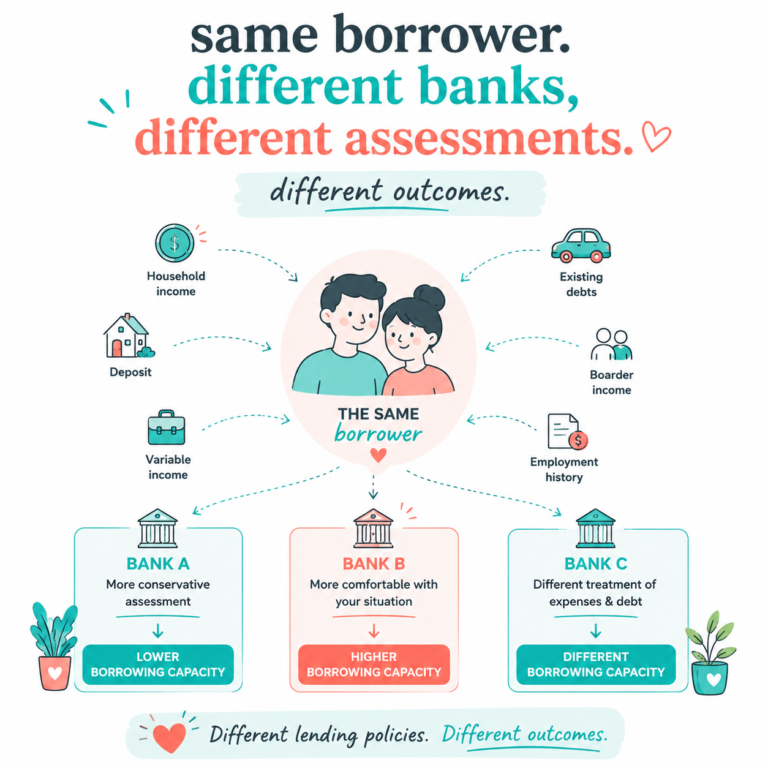
Those differences can apply to almost every part of an application, including:
- Household expenses
- Commission and bonus income
- Overtime
- Seasonal or variable income
- Income from a second job
- boarder income
- Credit card limits
- Existing personal debt
- Self-employed income
- Recent employment changes
- Low-deposit applications
And that’s before looking at things like your savings history, spending habits, credit profile and the property you’re buying.
If you’re wondering exactly what banks look at when assessing a mortgage, I’ve broken down the main factors in What do banks look at when assessing a home loan?.
One lender may take a more conservative approach to one part of your application, while another may be more comfortable with it.
That’s why choosing a lender isn’t simply about asking:
“Which bank has the lowest interest rate?”
Sometimes the more important question is:
“Which lender is most likely to work with my particular situation?”
One bank saying no doesn’t mean every bank will say no
This is an important distinction.
I’m not saying that if one bank declines you, another bank will definitely approve you.
Sometimes there are genuine affordability, deposit, credit or policy issues that need to be addressed first.
But a lender saying no doesn’t necessarily mean you can’t buy a home.
It may simply mean:
“We can’t make this application work under our lending policy.”
Those are two very different things.
I’ve seen this play out with clients who initially thought their chance of buying had disappeared.
When different lenders assess income differently
One couple came to me with a property under offer. It was a new build due to be completed later in the year, and they’d already spoken to several banks.
The lending figures they’d been given ranged from around $495,000 to $630,000.
Their circumstances weren’t straightforward. They had seasonal income and a second casual role that hadn’t been going for very long.
Some lenders weren’t comfortable considering the second role because of how recently it had started.
We were able to demonstrate a consistent pattern of income over the previous three years, including casual work during the client’s usual off-season.
After approaching a number of lenders and working through how each would assess their circumstances, we were ultimately able to secure $643,500 in lending — just enough for them to proceed with the home they wanted.
The difference wasn’t that we found a bank that ignored the rules.
We found a lender whose assessment approach was a better fit for the evidence and circumstances they could provide.
Sometimes the answer isn't another bank — it's getting your application presented better
Another client was looking to purchase a property from family.
The bank initially said no and sent her away with a few things to tidy up first.
She needed to clear some debt, provide more clarity around the property title and strengthen the overall application.
It would have been easy to interpret that initial answer as:
“The bank won’t lend to me.”
But that wasn’t really the message.
The message was:
“This application isn’t ready yet.”
A few months later, after addressing the issues the bank had identified, we approached the same bank again.
This time, the application was approved.
She’s now in her own home.
Sometimes the right answer isn’t finding a different lender at all.
Sometimes it’s understanding what needs to change before you approach the lender again.
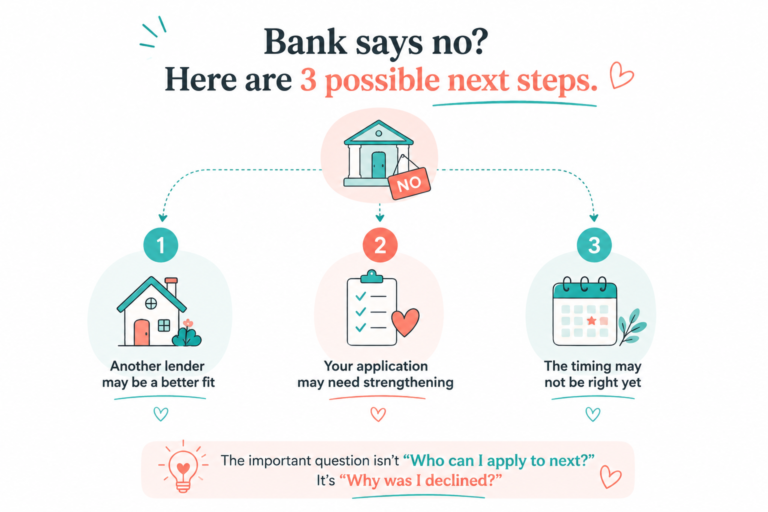
Sometimes you need to keep looking for the right fit
I also worked with a brother and sister who thought their chance of buying might have passed.
They initially had a 5% deposit and had found a property they loved. But the property presented lending challenges, their original plan no longer worked, and changes to their employment meant they no longer qualified for the Kāinga Ora First Home Loan they had been working towards.
Instead of giving up, they adapted.
They kept saving, paid off personal debt and grew their deposit from 5% to 10%.
We then worked through the available lender options and kept looking for a solution that fitted their updated circumstances.
Eventually, we found one.
Today they’re enjoying their first home, with boarders helping with the mortgage, and they have a solid foundation from which to grow their small business.
What made the difference?
They adapted when their circumstances changed.
They stayed committed to their goal.
And we didn’t assume that the first answer was the final answer.
It's not just about borrowing the most
Finding the right lender isn’t necessarily about finding the bank that will lend you the absolute maximum.
The better question is:
“Which lender gives me a sensible amount of lending, on terms that suit my circumstances and my plans?”
For example, one lender might offer a higher borrowing amount but have less flexibility around how you manage the loan.
Another might have features that are more useful to you, such as an offset or revolving credit facility.
The goal isn’t simply to get across the line.
It’s to get into the right lending structure for where you are now and where you want to go next.
So, how do you know which bank is right for you?
This is the bit you don’t necessarily know — and that’s okay.
You shouldn’t be expected to know the detailed lending policies of every bank.
That’s one of the reasons mortgage advice can be valuable.
My job isn’t simply to ask:
“Which bank do you want to use?”
It’s to look at your circumstances and ask:
“What type of lender is most likely to handle this application well, and why?”
If you have a low deposit, self-employed income, variable income, boarder income, recent employment changes or higher personal debt, those details can matter when deciding where to apply.
Sometimes the best lender will be obvious.
Sometimes there are a few viable options and we need to weigh up the differences.
And sometimes the answer is that you’re not quite ready yet — in which case, knowing what to work on can be far more useful than submitting an application that isn’t likely to succeed.
And if you’re assuming you need a 20% deposit before you can even talk to a bank, it’s worth reading How much deposit do you really need? first.
The bottom line
One bank saying no doesn’t automatically mean every bank will say no.
But it also doesn’t mean you should simply apply everywhere until someone says yes.
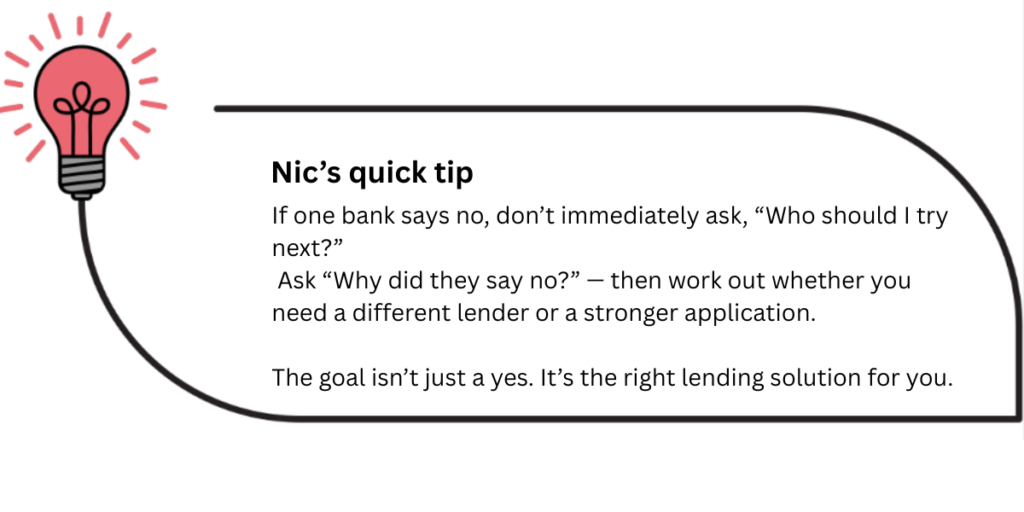
The smarter approach is to understand why the application didn’t work, whether another lender genuinely has a different approach that could help, and whether there are things you can improve before applying again.
Different banks have different lending criteria, different appetites and different ways of assessing risk.
The right lender isn’t necessarily the one that says yes to everyone.
It’s the one whose lending approach fits your circumstances and your goals.
And if you’re not sure which lender that is, that’s exactly the sort of thing a mortgage adviser can help you work out before you start applying.
Common myths about bank lending
If one bank says no, no bank will lend to me
Not necessarily.
All banks will lend roughly the same amount
Not always.
The bank with the lowest interest rate is always the best bank
Again, not always.
If I have a small deposit, I should just apply to every bank
Usually not.
*Your first home faster action*
Don’t apply to another bank just yet.
If you’ve been told no, or you’ve received a borrowing figure that doesn’t seem to stack up, take 15 minutes to work out why.
Ask yourself:
- What part of my application is making things difficult?
- Is it my deposit, income, debts, expenses or employment situation?
- Is this something another lender might assess differently?
- Or is there something I can improve before I apply again?
If you’re not sure, that’s okay. You don’t need to know every bank’s lending policy yourself.
Your next step: Get your First Home Faster toolkit and use it to work through where you stand, what lenders will look at and what you can do to strengthen your position.
Get the free First Home Faster toolkit →
A better plan can be more valuable than simply applying to another bank.
A few questions I get asked all the time
Can I apply to another bank if I've been declined?
Potentially, yes — but first find out why you were declined.
If the issue is specific to that lender’s policy, another lender may assess the situation differently. If the issue is affordability, debt, credit history or another underlying problem, changing lenders may not solve it but it’s better to know how you can improve the situation.
Do all banks have the same mortgage lending criteria?
No.
All lenders operate within broader responsible lending requirements, but their individual lending policies and assessment methods can differ.
This can affect how they treat things such as variable income, self-employed income, boarder income, credit card limits, household expenses and recent employment changes.
Why can one bank lend me more than another?
Different lenders can make different assumptions when assessing your application.
They may use different household expense benchmarks, treat certain types of income differently, or have different policies around existing debts and other commitments.
That’s why an online borrowing calculator should only ever be treated as a guide.
Will applying to multiple banks hurt my chances of getting a mortgage?
It’s not a good idea to submit multiple applications without first understanding which lender is likely to be the best fit.
Credit enquiries are one part of your overall credit profile, so there’s little benefit in making unnecessary applications if you could have narrowed down your options first.
How do I know which bank is best for my situation?
That’s where a mortgage adviser can help.
Rather than starting with a particular bank, start with your circumstances.
A good adviser can look at your income, deposit, debts, employment, spending and goals, then identify which lenders are worth considering and explain why.
Want to know what you should have ready before talking to a bank?
I’ve created my First Home Faster toolkit to help first-home buyers understand what lenders look at, what documents you’ll need and the key things to think about before you start house hunting.
It’s designed to help you get organised and understand the process before you get to the application stage.
Get the First Home Faster toolkit →
Because the more you understand before you apply, the easier it is to make a good decision about your next step.