In this article you’ll learn
- Why the deposit you’re saving for might not be the deposit you actually need
- What lenders consider alongside your deposit
- How to work out a realistic deposit target for your situation
- Why getting advice early can help you buy sooner
5-minute read
How much deposit do you really need? Stop saving for the wrong number
One of the most common questions I get from first-home buyers is:
“How much deposit do I actually need?”
And the answer surprises a lot of people.
There isn’t one magic number.
The amount of deposit you need depends on your income, debts, KiwiSaver, savings, the property you’re looking to buy, your overall financial position and the lending options available to you.
Are you saving for a target, or just saving?
I speak to people all the time who tell me:
“We’re not ready yet.”
“We want to get our bank statements looking better first.”
“We’ll probably buy in a year or two.”
“We’ll wait until we’ve saved another $50,000.”
“We’re waiting until our income increases.”
All of those things can be sensible reasons to wait.
But sometimes they’re based on an assumption rather than an actual lending target.
For example, someone with $60,000 saved might feel like they’re nowhere near buying because they’ve assumed they need a 20% deposit on a $700,000 home.
That’s a $140,000 target.
It feels a long way away.
But what if their actual pathway to buying looked different?
Depending on their income, debts, expenses, KiwiSaver, the property they buy and the lenders available to them, they may not need to reach $140,000 before they can consider buying.
That doesn’t mean everyone with $60,000 can buy a $700,000 home. It means you can’t work out whether you’re ready simply by looking at your deposit and comparing it with 20%.
Your deposit is only one part of the lending equation.
If you’re wondering whether you really need 20%, I’ve covered that in more detail here: Do you need a 20% deposit to buy your first home in New Zealand?
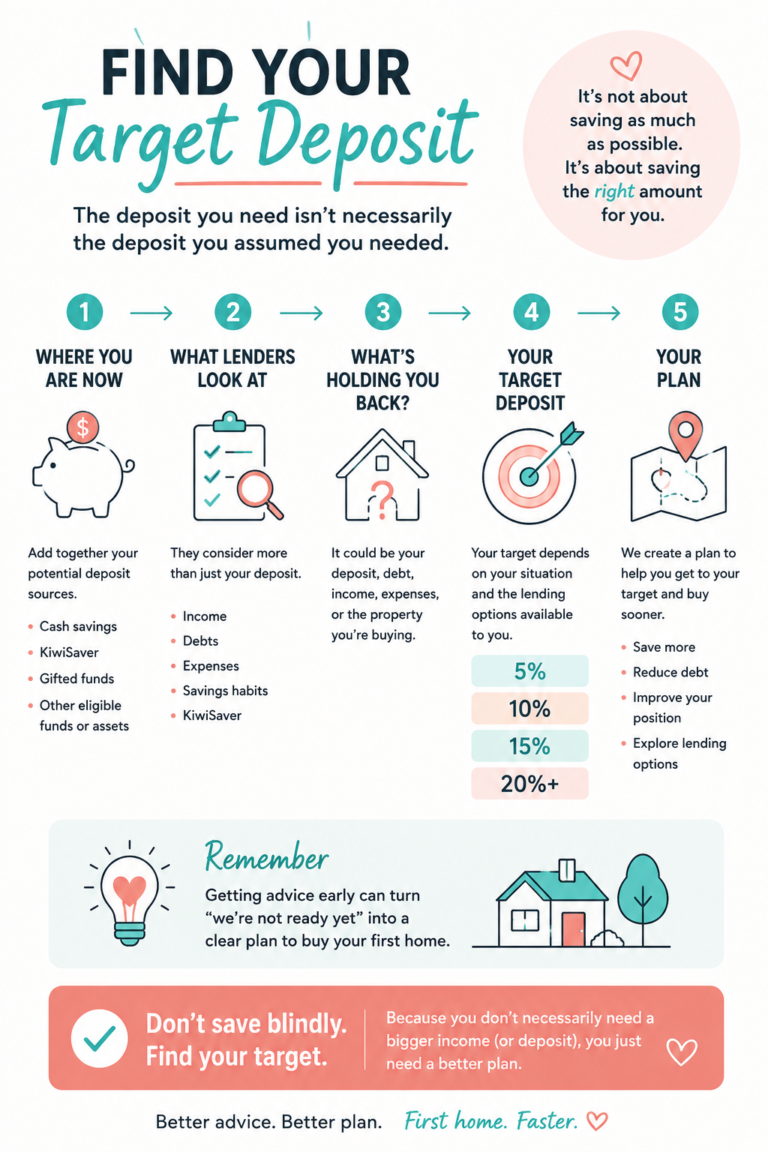
Find your target deposit
Instead of asking:
“How much deposit can I possibly save?”
I’d encourage you to ask:
“What deposit do I realistically need for my situation?”
Those are two very different questions.
Your target deposit should be based on where you are now, what you want to buy and what you need to do to open up the right lending options for you.
For some buyers, that might mean getting into a position where a low-deposit lending option could work.
For others, it might mean focusing on getting from 5% to 10% to open up more options.
For someone else, the deposit might not actually be the biggest issue at all. Paying down a particular debt could improve their borrowing capacity and free up cashflow to build their deposit faster.
And sometimes the best strategy is simply to keep saving while you work on getting everything else in order.
The point is to know which one applies to you.
Your deposit isn't necessarily just your savings
Another common misconception is that your deposit has to come entirely from money sitting in your savings account.
Depending on your circumstances and the lender’s requirements, your deposit may be made up of a combination of:
- Your savings
- KiwiSaver
- Gifted funds
- Other investments or assets
And the bank won’t look at your deposit in isolation.
Your deposit is just one part of the picture. They’ll also consider things like your income, existing debts, regular expenses, savings history and the overall strength of your application. I explain in more detail the other factors banks consider in What do banks look at when you apply for a home loan?
That’s why two people with exactly the same amount of savings can have very different pathways to buying a home.
Sometimes buying sooner is the better plan
There can also be a bigger strategic question to consider:
Would you be better off buying sooner, or saving for longer?
There isn’t a universal answer.
A larger deposit can give you more lending options and potentially better loan pricing. Saving more can also reduce the amount you need to borrow.
But continuing to save simply because you don’t know whether you’re ready is different from deliberately choosing to save for a larger deposit.
For some buyers, buying sooner could mean using their income to aggressively pay down their mortgage, build equity and improve their lending position over time.
For others, waiting and building a larger deposit may be the better option.
The important thing is understanding the trade-off rather than automatically assuming that “more deposit” is always the answer.
Real client story
I recently worked with a couple who settled on their first home in Auckland with a 5% deposit.
When they first came to me, they already had around 5% saved but weren’t sure whether it was enough.
They knew there was a low-deposit option available with a mainstream bank, but they weren’t likely to qualify for the Kāinga Ora First Home Loan because of their income.
They could have simply decided to keep saving for another few years.
Instead, we looked at whether buying sooner could actually make sense for them.
We looked at the potential repayments, compared those with their current rent and savings position, considered their income and future plans, and worked through what their lending position could look like.
Importantly, they understood the trade-offs.
A 5% deposit meant they wouldn’t necessarily have access to the same lending options or pricing as someone with a larger deposit. They also couldn’t rely on getting a traditional pre-approval, so they needed to be comfortable with the numbers before proceeding with a property and a live application.
Once they understood the potential repayments, the interest rate that could apply and their plan for making extra repayments and building equity, they had the confidence to move forward.
They’re now not sitting on the sidelines trying to save another $50,000.
They’re in their own home, building equity and working towards improving their position over time.
That doesn’t mean 5% is the right deposit for everyone.
It means 5% was worth investigating for them.
And that’s the difference.
They didn’t need someone to tell them that 5% was “enough”.
They needed to know whether 5% could work for their situation.
*Your first home faster action*
If you’re currently saving for your first home, grab a piece of paper and write down:
- My current deposit: $________
- My current deposit target: $________
- Why I chose that target: __________________
Then ask yourself:
“Is this number based on actual advice, or is it simply the number I assumed I needed?”
If you don’t know, that’s okay.
That’s exactly the point.
If you’re wondering whether you’re actually closer to buying than you realise, take a look at 5 signs you might be closer to buying your first home than you think.
You don’t necessarily need to wait until you’ve saved “enough” before you start planning.
In fact, getting advice earlier can help you work out what “enough” actually means for you.
It might mean tidying up a few small debts.
It might mean improving your account conduct and savings habits.
It might mean putting aside the extra $5,000 you’ll need for pre-purchase costs.
It might mean continuing to save until you reach a particular deposit target.
Or it might mean discovering that you’re closer to buying than you thought.
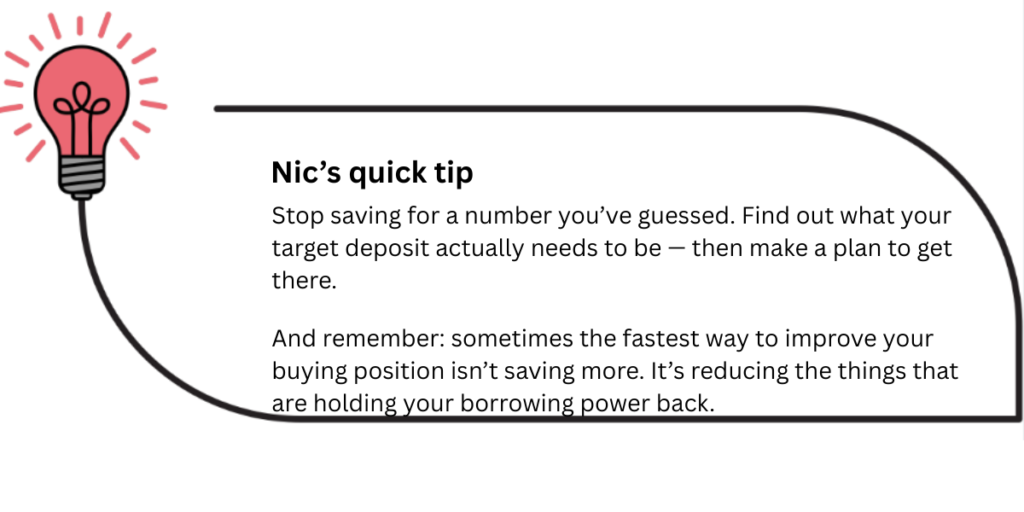
Don’t just save blindly. Find your target.
Because you don’t necessarily need a bigger income or a bigger deposit to buy your first home sooner.
Sometimes, you just need a better plan.
A few questions I get asked all the time
How much deposit do I need to buy a house in New Zealand?
There isn’t one deposit amount that applies to everyone. Some first-home buyers may be able to purchase with a deposit of around 5%, while others may need a larger deposit depending on their circumstances, the property they’re buying and the lender involved. A mortgage adviser can help you work out what deposit target may be realistic for you.
Can I buy my first home with a 5% deposit?
Potentially, yes. Some lending options are available to eligible buyers with a deposit around 5%, although approval isn’t automatic and lender criteria apply. Your income, debts, expenses, savings history, the property and your overall financial position will all be considered.
Do I need a 20% deposit to buy my first home?
No. A 20% deposit is not the only way to buy a first home in New Zealand. There are circumstances where lenders may approve buyers with less than 20%, although lower-deposit lending can come with additional requirements, restrictions or different interest rates. Read more in Do you need a 20% deposit to buy your first home in New Zealand?
Can gifted money be used for a house deposit?
Potentially, yes. Some lenders will accept gifted funds as part of a deposit, but there may be requirements around how the gift is documented and whether the money genuinely doesn’t need to be repaid. Your lender will need to be comfortable with the source and nature of the funds.
Is it better to wait and save a bigger deposit?
Not necessarily. A larger deposit can give you more lending options and potentially better loan pricing, but waiting isn’t automatically the best strategy for everyone. The right decision depends on your borrowing capacity, deposit, property goals, available lending options and what your finances could look like if you bought sooner.
Should I talk to a mortgage adviser before I have a 20% deposit?
Absolutely. In fact, getting advice before you reach your assumed deposit target can help you work out what you actually need. You may discover that you’re closer than you thought, or that there are specific things you can work on now — such as reducing debt, improving your savings pattern or building your deposit — that could make a meaningful difference when you’re ready to buy.
Want to work out what your target should be?
My First Home Faster Toolkit takes you through the key steps from getting your deposit organised and preparing for pre-approval through to making an offer and settling on your first home.
Download the free First Home Faster Toolkit → or get in touch today to chat through your options.